In short
In Charcot foot, the bones and joints of a foot with nerve damage become inflamed, weaken, break and can change shape. Charcot foot in diabetes usually shows as a red, warm, swollen foot that may not hurt much. You should be seen by a specialist foot team within 1 working day. Treatment usually means months in a knee-high cast or boot that cannot be taken off. A change in shape is not usually reversed, but early treatment can limit it.
Charcot foot is uncommon but serious. The bones and joints in the foot become inflamed, can break and may change shape. It develops in feet with nerve damage, most often in people with diabetes.2 This Charcot foot diabetes guide explains what to look for and how it is treated. Spotting it early and keeping weight off the foot can limit lasting harm. It is part of our diabetic foot overview.
What is Charcot foot?
The medical name is Charcot neuro-osteoarthropathy. It is an inflammation in people with neuropathy (nerve damage) that injures the bones, joints and soft tissues.2 Broken bones may not heal properly, joints can slip out of place and the arch of the foot can collapse.3
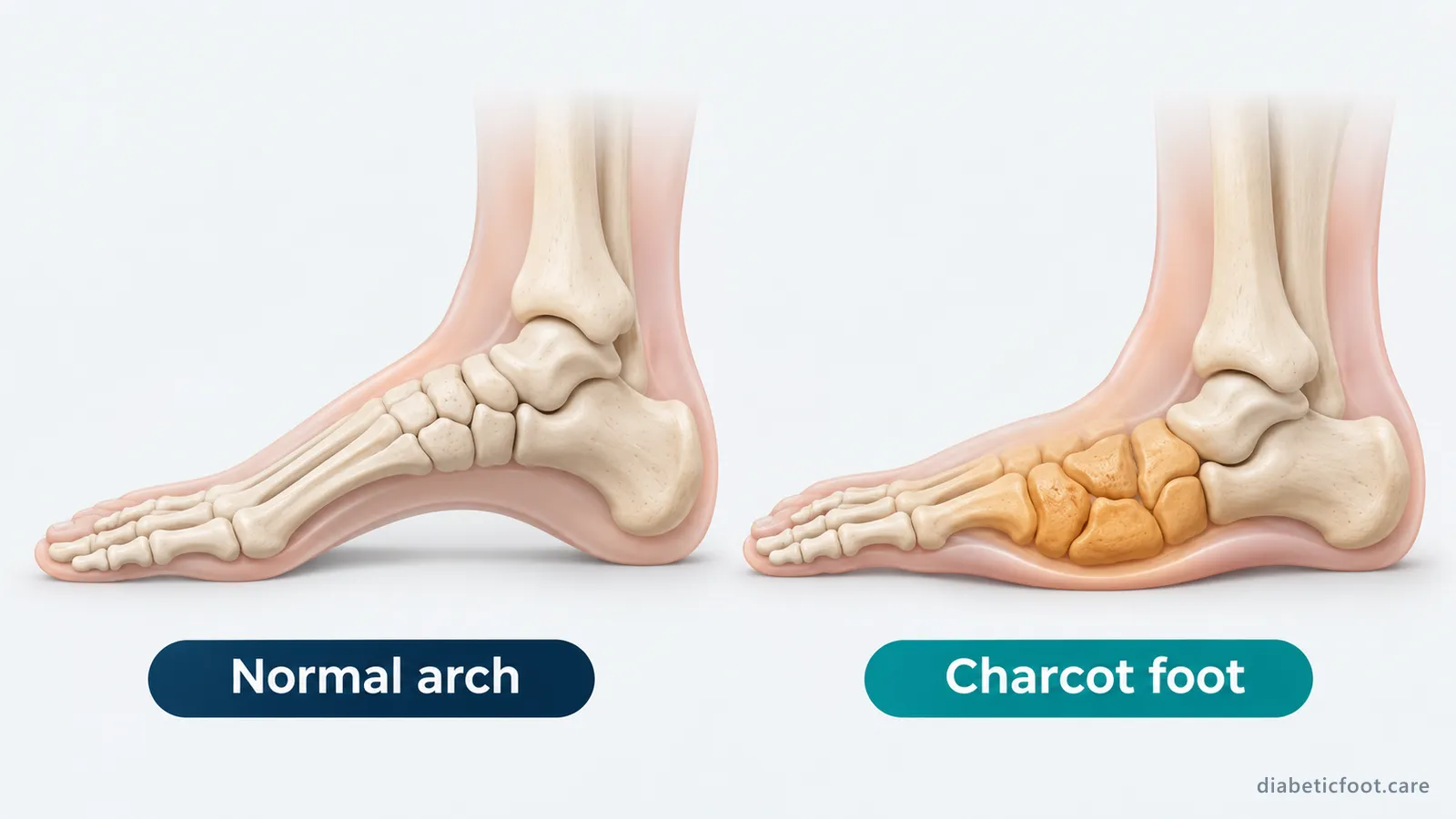
Because your foot has lost feeling, you may keep walking on it. The pressure can change the shape of the bones and joints.3 A foot that has changed shape is then more likely to get ulcers (open sores).3
Charcot foot diabetes risk: who is most likely to be affected?
Your risk is higher if you:
- have nerve damage in your feet (peripheral neuropathy), especially if you have lost feeling13
- have had diabetes for a long time3
- have kidney failure1
- have recently broken a bone in your foot or ankle, as this can lead on to Charcot foot1
Not sure whether you have nerve damage? Our page on diabetic foot pain and neuropathy explains how it is checked.
Active and chronic phases
Charcot foot in diabetes goes through two broad phases, and treatment depends on which one you are in.
| Phase | What is happening | Typical signs | Main aim of care |
|---|---|---|---|
| Active | Inflammation, with bones and joints weakening or breaking | Red, warm, swollen foot; often little or no pain | Keep the foot still and take weight off it quickly |
| Remission (inactive or chronic) | Inflammation has settled and broken bones have knitted together | Temperature close to the other foot again; the change in shape may remain | Protect the foot with suitable footwear and regular check-ups |
Early on, an X-ray can look normal even when an MRI scan shows changes in the bone.2 Specialists say "in remission" rather than "healed", because it can flare up again in the same foot.2
Symptoms of Charcot foot to look out for
The main signs are:3
- a swollen foot or ankle
- a foot or ankle that feels warmer than the other one
- a change in colour, often redness
- a change in the shape of your foot
It may not hurt much, or at all. Even without pain or a change in shape, your doctor or nurse should think of Charcot foot, especially if the skin is unbroken.1 Our guide to diabetic foot symptoms covers other early warning signs.
If you notice these changes, take the weight off the foot straight away. Sit or lie with your foot raised on a cushion so it touches nothing, and get help the same day.34
How Charcot foot is diagnosed
NICE, which sets guidance for the NHS, says that if Charcot foot is suspected you should be referred to the hospital foot team within 1 working day. This team (the multidisciplinary foot care service) may include diabetes doctors, podiatrists, surgeons and plaster staff. They should then assess you within 1 more working day. Until then, you should be offered care that keeps weight off the foot.1
Tests usually include:
- An X-ray of the foot and ankle taken while you stand, ideally of both feet to compare them.12
- An MRI scan if the X-ray is normal but Charcot foot is still suspected.12
- Skin temperature checks, comparing the same spot on both feet with an infrared thermometer.2
Blood tests alone cannot confirm or rule out Charcot foot.2
Charcot foot or infection?
A red, hot, swollen foot can also be caused by infection, gout or a blood clot, so these need to be ruled out.2 Charcot foot is most likely when the skin is unbroken and you have never had an ulcer.2 If there is a wound, the team will look carefully for deep infection, including bone infection, known as diabetic foot osteomyelitis. This is treated as an emergency that can put the leg at risk.1
How is Charcot foot treated?
Offloading in a cast or boot
The main treatment is to keep the foot still and take pressure off it (offloading), ideally as soon as Charcot foot is suspected.2 Experts recommend a knee-high cast or boot that cannot be taken off:2
- first choice: a total contact cast, moulded closely to your lower leg and foot
- second choice: a knee-high walking boot fixed so it cannot be removed
- third choice: a removable knee-high boot worn all the time, if a fixed one is not suitable
Shoes, sandals and supports that stop below the ankle are not recommended while it is active.2 You may be given crutches, a walking frame or a wheelchair to keep weight off the foot.23 Do not try to take a cast off yourself.3

How long treatment lasts
Treatment usually takes several months, sometimes longer.3 Your team will check progress with temperature readings and repeat X-rays. The active phase has probably settled when the temperature difference between your feet stays below 2 degrees and X-rays show no more change.1 Experts suggest keeping weight off for a few more weeks, then walking again gradually, because loading the foot fully all at once can cause a flare.2
Bone medicines called bisphosphonates are not recommended for active Charcot foot, except in research trials.1
Footwear and surgery
Once the active phase is over, shoes and insoles shaped to fit your foot help stop it flaring again. If the foot has changed shape or is unstable, you may need a custom-made below-knee support.2 Surgery may be an option if joints are unstable, the shape of the foot makes ulcers very likely, or a cast cannot hold the foot steady.2 A foot changed by Charcot is at high risk of ulcers, so you should stay under the foot protection service for life.1
Can diabetic Charcot foot be reversed?
A change in shape that has already happened is not usually reversed, and active Charcot foot can leave the foot permanently changed.2 Taking weight off early aims to settle the condition and stop the shape changing, or changing further.23 Diabetes UK says that in most cases Charcot foot does not lead to surgery or amputation.3
Frequently asked questions
Is Charcot foot painful?
How long does Charcot foot take to heal?
Most people with diabetic Charcot foot need several months in a cast or knee-high boot, and some need longer.3 Your foot is said to be in remission when the temperature difference between your feet stays low and X-rays stop changing.1 After that, you return to walking gradually, in shoes made to fit your foot.2
How does a total contact cast treat diabetic Charcot foot?
Can you walk with Charcot foot?
Can Charcot foot come back?

Specialist assessment in Istanbul
Would you like a specialist opinion?
Assoc. Prof. Dr. Hüsrev Diktaş is an infectious diseases and clinical microbiology specialist in Istanbul with a clinical focus on diabetic foot infections. International patients can ask about an assessment directly.
References
- National Institute for Health and Care Excellence (NICE). Diabetic foot problems: prevention and management (NG19), recommendations. 2015, updated 2023. https://www.nice.org.uk/guidance/ng19/chapter/Recommendations
- International Working Group on the Diabetic Foot (IWGDF). Guidelines on the diagnosis and treatment of active Charcot neuro-osteoarthropathy in persons with diabetes mellitus (IWGDF 2023). 2023. https://iwgdfguidelines.org/wp-content/uploads/2023/07/IWGDF-2023-08-Charcot-Guideline.pdf
- Diabetes UK. Charcot foot and diabetes. 2024. https://www.diabetes.org.uk/about-diabetes/looking-after-diabetes/complications/feet/charcot-foot
- Diabetes UK. Serious foot problems and diabetes. 2024. https://www.diabetes.org.uk/about-diabetes/looking-after-diabetes/complications/feet/serious-foot-problem
This page gives general information for people in the UK. It is not a diagnosis and does not replace advice from your own GP, diabetes team or foot protection service. Medical disclaimer · How we write our content