In short
Diabetic foot care means checking your feet every day, washing and drying them carefully, and moisturising dry skin but not between the toes. Cut nails straight across, never walk barefoot and wear shoes that fit well. Stopping smoking and keeping blood glucose, blood pressure and cholesterol in range also protect your feet. Go to your free annual foot check. If you are at higher risk, you should be referred to a foot protection service.
In this section
Diabetes can reduce the feeling and the blood supply in your feet. That means a small blister or cut can turn into an ulcer or infection before you notice it. The good news is that most of these problems, including amputations, can be prevented with simple daily habits and regular checks.1 This guide to diabetic foot care covers a daily routine, shoes and socks, nails and hard skin, your general health and the NHS services that can help. To understand why diabetes affects the feet, see our guide to diabetic foot problems and their causes.

Why does diabetic foot care matter?
Over time, high blood glucose can damage the nerves and small blood vessels that supply your feet. With damaged nerves, you may not feel a stone in your shoe or a burn. With reduced blood flow, wounds heal more slowly.7 The NHS lists foot ulcers and infections among the long-term complications of type 2 diabetes, and they sometimes lead to amputation.8
Problems can also get worse quickly, especially once the feeling in your feet has changed.1 So if you are at risk, look at your feet every day. If you see anything new, contact your GP practice, practice nurse or podiatrist quickly.2
A daily diabetic foot care routine
This routine only takes a few minutes a day.
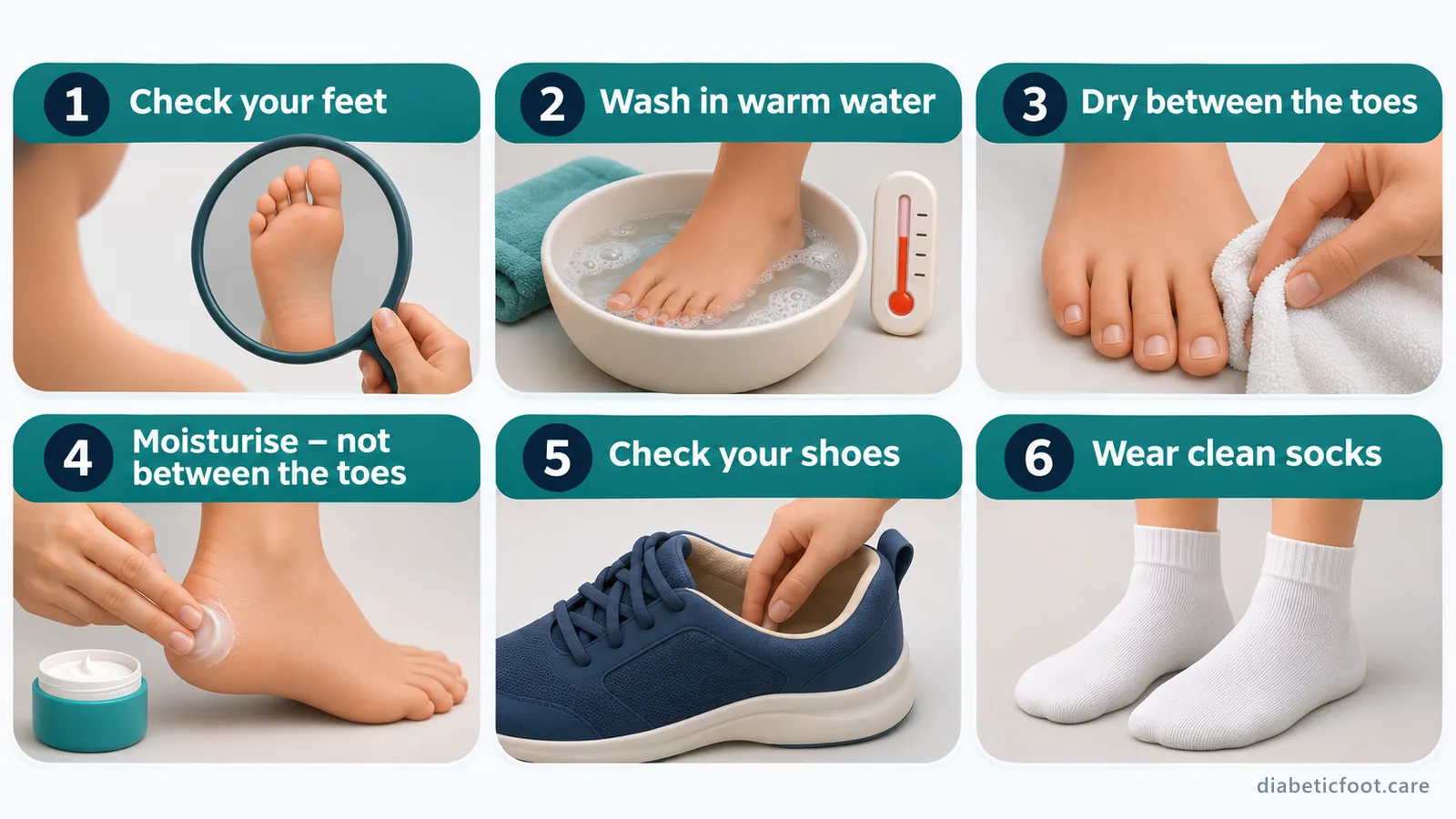
| Task | How to do it | Why it helps |
|---|---|---|
| Check your feet | Look at the tops, soles, heels and between your toes, morning and evening. Use a mirror or ask a family member or carer to help | Finds blisters, cuts and colour changes early12 |
| Wash | Use soap and warm, not hot, water. Test the temperature with your wrist or elbow first, and do not soak your feet | Keeps feet clean; soaking makes skin easier to damage1 |
| Dry | Dry carefully, especially between the toes | One of the main steps in preventing ulcers2 |
| Moisturise | Rub moisturiser (an emollient) into dry skin, but not between the toes | Keeps the skin healthy12 |
| Check shoes | Feel inside for stones, sharp objects or rough linings before you put them on | Stops rubbing and puncture wounds you might not feel1 |
| Protect | Wear socks and shoes, or slippers with firm soles, at all times, indoors and out | Avoids pressure and injury from bare feet2 |
Our separate article on the diabetic foot check explains how to check your feet properly, what to look for and what happens at your annual review.
Washing, moisturising and nail care
Wash your feet every day with soap and warm water. Before your feet go into the bowl or the bath, check the temperature with your wrist or elbow, because numb feet cannot judge heat.1 Do not soak your feet, as soaking makes the skin easier to damage.1
If the skin on your feet is cracked, see your GP or diabetes nurse about it.8 Using a moisturiser every day keeps skin healthy, and creams containing urea can be useful. Your GP practice or podiatrist can suggest one.1 Do not put cream between your toes, and keep talcum powder away from there too, as it can clog and cause rubbing.1
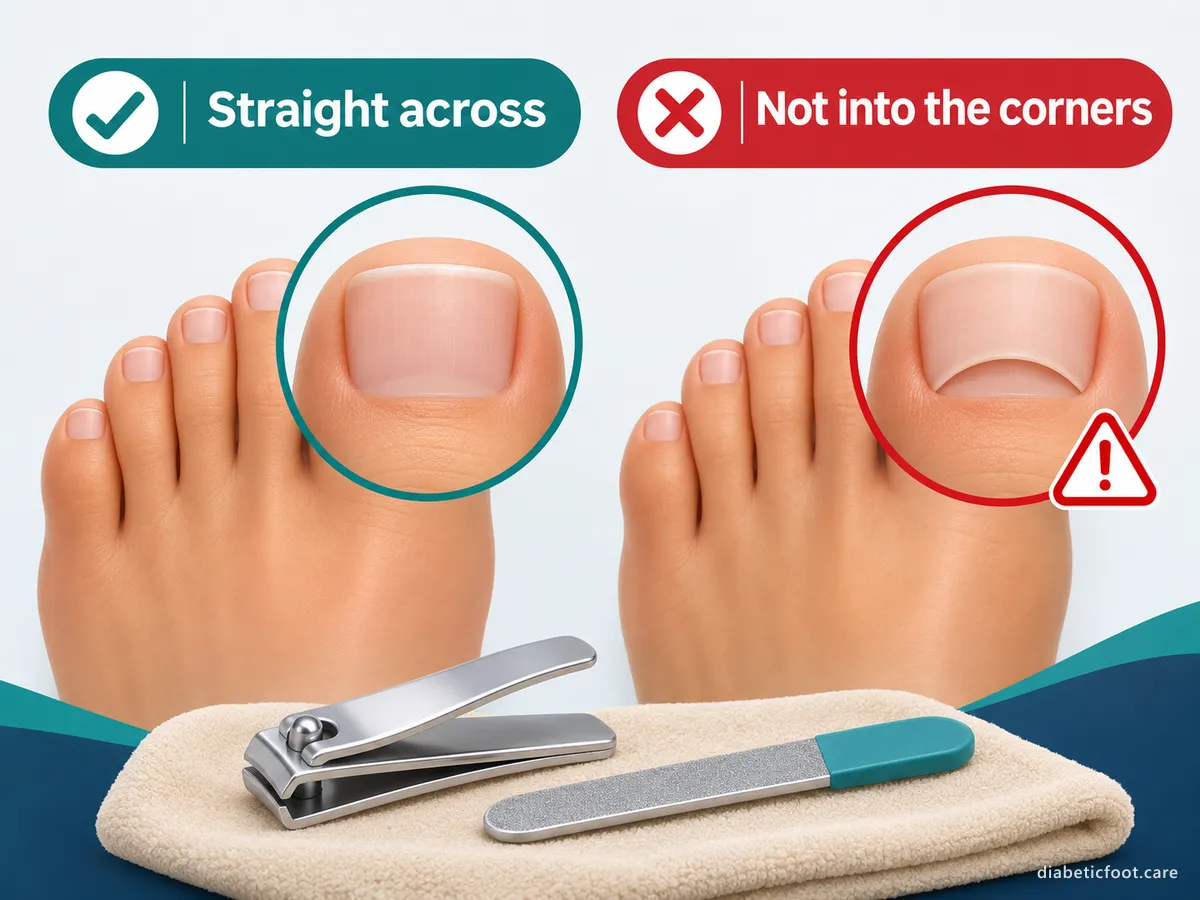
Cut your toenails straight across.2 It also helps to:1
- cut them regularly, but not too short and not down the sides
- use nail clippers, then file any sharp corners with an emery board
- clean under them gently with a nail brush, never with the points of scissors
- see a podiatrist (foot specialist) if your nails are thick, ingrown or hard to reach, or if you have lost feeling in your feet
Choosing shoes and socks for diabetic feet
Shoes that do not fit well can cause problems or make existing ones worse, even if they feel comfortable.1 When you buy shoes or trainers, look for a pair that is:1
- wide fitting, with a deep, rounded toe area
- flat or low heeled
- fastened with laces, a strap or a buckle, so your foot does not slide around
Wear new shoes around the house for 20 to 30 minutes at first to check they do not rub.1 Avoid socks or tights with holes or thick seams, and replace worn insoles and linings.1

If you have a foot deformity, an area of skin close to breaking down (a pre-ulcer) or a previous ulcer, ordinary shoes may not be enough. Extra-depth or made-to-measure shoes and insoles are recommended if your foot has changed shape. If you have had an ulcer on the sole, you may need special footwear shown to reduce pressure, worn indoors and outdoors.2 In the UK, the foot protection service assesses whether you need them.3
Corns, calluses and hard skin
Hard skin and corns build up where shoes press or rub. Do not cut them with blades, and avoid corn plasters, creams or sprays. These can burn the skin and cause ulcers.1 A pumice stone, used gently, can help with mild hard skin.1
Thick callus, ingrown toenails and fungal infections should be treated by a podiatrist or other trained professional, because treating them helps prevent ulcers.2 Our article on diabetic foot blisters and calluses explains why a callus can sometimes hide damage underneath.
Protecting your feet from heat and injury
If your feet have lost some feeling, everyday heat and minor knocks become real risks.
- Do not walk barefoot, in socks without shoes or in thin-soled slippers, even at home.2
- Never rest your feet on a hot water bottle. Use a cover, never fill it with boiling water, and take it out of the bed before you get in.5
- Keep useful numbers handy, such as your GP practice, your podiatrist or foot team and the out-of-hours service.1
Looking after your general health
Diabetic foot care is not only about your feet. What happens in the rest of your body shows up there too, so Diabetes UK recommends these steps:1
- Stop smoking. Smoking makes it harder for blood to reach your feet and raises the risk of amputation. Your GP practice or diabetes team can help you quit.
- Manage blood glucose, cholesterol and blood pressure. Keeping them close to your targets helps prevent foot damage or stop it getting worse.
- Eat a balanced diet and stay active. Activity helps you manage diabetes. If you are at low or moderate risk, walking about 1,000 extra steps a day is likely to be safe. Wear suitable shoes and keep checking your skin.2
Foot checks, podiatry and the foot protection service
At your annual diabetes review, a trained professional such as a practice nurse or podiatrist should check your bare feet. This part of your diabetic foot care is free on the NHS.4 NICE, which sets guidance for the NHS, says your feet should be checked when you are diagnosed and at least once a year after that. They should also be checked whenever a foot problem comes up and if you are admitted to hospital.3
At the check, you will be told your risk of developing a foot problem. If you are at moderate or high risk, you should be referred to a foot protection service. This team should check your feet, provide skin and nail care, see whether you need special footwear or insoles, and check the circulation in your legs.3 If you notice a problem, do not wait for your next routine check. Ask for an earlier appointment.1
If you already have a wound, our section on diabetic foot ulcers explains how they are assessed and treated.
Frequently asked questions
How can I prevent diabetic foot problems?
Good diabetic foot care means checking your feet every day, washing and drying them carefully, moisturising dry skin, cutting your nails straight across and never walking barefoot.2 Wear shoes that fit well, stop smoking and keep your blood glucose, blood pressure and cholesterol close to target.1 Go to every annual foot check. If you are at moderate or high risk, go to your foot protection service appointments.3
What shoes should I wear with diabetes?
Choose shoes or trainers that are wide fitting, with a deep, rounded toe area and a flat or low heel. Laces, a strap or a buckle stop your foot sliding.1 Wear new shoes around the house for short spells at first. If your foot has changed shape or you have had an ulcer, ask your podiatrist about extra-depth or made-to-measure shoes and insoles.2
Is diabetic foot care free on the NHS?
The foot check at your annual diabetes review is free on the NHS.4 If it shows you are at moderate or high risk, you should be referred to the foot protection service. This service offers ongoing diabetic foot care, including foot checks, skin and nail care and advice on footwear.3 If you are not sure how podiatry is arranged in your area, ask your GP practice.
How should I cut my toenails if I have diabetes?
Cut them straight across, not too short and not down the sides. Use nail clippers, then smooth any sharp corners with an emery board.12 Never dig into the corners or clean under the nail with the points of scissors. If your nails are thick, curved, ingrown or hard to reach, or your feet are numb, ask a podiatrist to help.1
Can I use moisturiser on diabetic feet?
Yes. Using a moisturiser (emollient) every day helps stop dry skin cracking, and creams containing urea can be useful. Your GP practice or podiatrist can suggest one.1 Smooth it over the tops, soles and heels, but not between your toes. Keep talcum powder away from there too, as it can clog and cause rubbing.1

Specialist assessment in Istanbul
Would you like a specialist opinion?
Assoc. Prof. Dr. Hüsrev Diktaş is an infectious diseases and clinical microbiology specialist in Istanbul with a clinical focus on diabetic foot infections. International patients can ask about an assessment directly.
References
- Diabetes UK. How to look after your feet. 2024. https://www.diabetes.org.uk/about-diabetes/looking-after-diabetes/complications/feet/taking-care-of-your-feet
- International Working Group on the Diabetic Foot (IWGDF). Guidelines on the prevention of foot ulcers in persons with diabetes (IWGDF 2023 update). 2023. https://iwgdfguidelines.org/wp-content/uploads/2023/07/IWGDF-2023-02-Prevention-Guideline.pdf
- National Institute for Health and Care Excellence (NICE). Diabetic foot problems: prevention and management (NG19), recommendations. 2015, updated 2023. https://www.nice.org.uk/guidance/ng19/chapter/Recommendations
- Diabetes UK. Your annual diabetes foot check. 2024. https://www.diabetes.org.uk/about-diabetes/looking-after-diabetes/complications/feet/what-can-i-expect-at-my-annual-foot-check
- Care of Burns in Scotland (COBIS), NHS National Services Scotland. Help prevent hot water bottle scalds and burns this winter. 2023. https://www.nn.nhs.scot/cobis/?p=2936
- Diabetes UK. Serious foot problems and diabetes. 2024. https://www.diabetes.org.uk/about-diabetes/looking-after-diabetes/complications/feet/serious-foot-problem
- Diabetes UK. Diabetes and foot problems. 2024. https://www.diabetes.org.uk/about-diabetes/looking-after-diabetes/complications/feet
- NHS. Complications of type 2 diabetes. 2025. https://www.nhs.uk/conditions/type-2-diabetes/complications/
This page gives general information for people in the UK. It is not a diagnosis and does not replace advice from your own GP, diabetes team or foot protection service. Medical disclaimer · How we write our content