In short
A diabetic foot check is a short check of your bare feet, usually at your annual diabetes review. A trained professional looks at your skin and foot shape, tests feeling with a 10 g monofilament, checks your pulses and asks about past ulcers, smoking and kidney problems. You are then told whether your risk is low, moderate, high or active, which decides how often your feet are checked. Between reviews, check your own feet every day.
A diabetic foot check (sometimes called diabetic foot screening) is a quick look at your feet. It checks for early signs of nerve damage, poor circulation and skin or shape changes, before they cause harm. In the UK it is part of your annual diabetes review and is free on the NHS.2 This page explains the review, your risk result and how to check your feet at home. It is part of our wider guide to diabetic foot care.
When should you have a diabetic foot check?
NICE, which sets guidance for the NHS, says adults with diabetes should have their foot risk assessed:1
- when diabetes is first diagnosed
- at least once a year after that
- whenever a new foot problem appears
- if they are admitted to hospital
Your GP practice or diabetes clinic arranges these checks. Keep going to them even if you already see a podiatrist.2
What happens at your foot review
You will be asked to take off your shoes, socks or tights and any bandages or dressings, so both feet can be seen, including between the toes.12 The check looks for:1
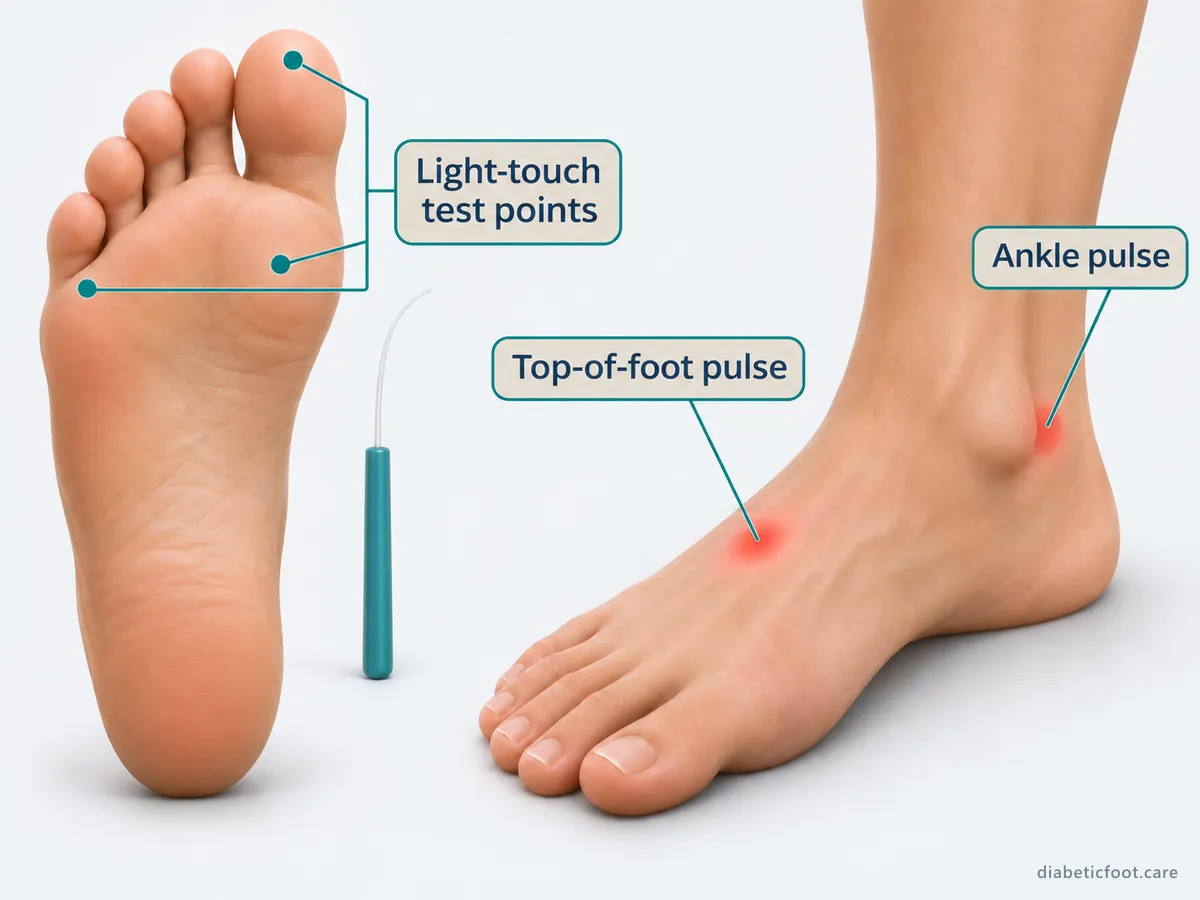
- nerve damage (neuropathy): a 10 g monofilament, a thin plastic thread that bends under light pressure, is touched on several points on your feet. A tuning fork may also be used to test vibration sense.12
- reduced circulation: they feel the pulses in your feet or listen to blood flow with a small handheld Doppler device2
- skin problems: ulcers, callus (hard skin), infection or inflammation
- changes in foot shape: such as clawed toes, or signs of Charcot foot
- gangrene: areas of dead tissue
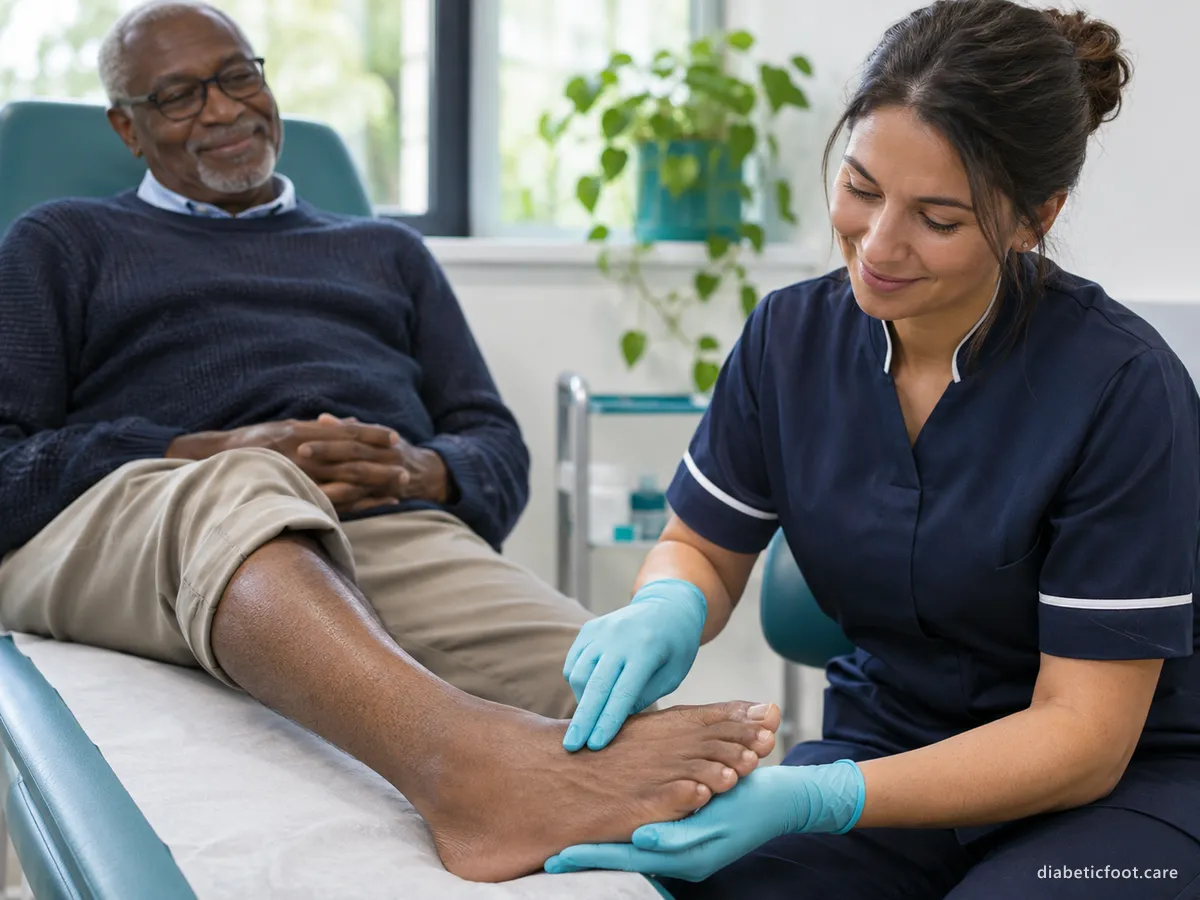
They will also ask about your health and habits, for example:2
- cuts, blisters, corns or broken skin you have noticed
- past foot ulcers, pain, or cramp-like leg pain when walking
- how often you check your own feet
Kidney dialysis and smoking also matter, as they affect your risk and your circulation.13 You will get advice on footwear, so it can help to bring the shoes or trainers you wear most.1
If the monofilament test shows reduced feeling, read about diabetic foot pain and nerve damage.
Understanding your foot risk level
At the end of your diabetic foot check, you should be told your risk of developing a foot problem. There are four levels:1
| Risk level | What it means | What usually happens next |
|---|---|---|
| Low | No risk factors, apart from callus on its own | Foot check at your annual diabetes review |
| Moderate | A change in foot shape (deformity), nerve damage or peripheral arterial disease (narrowed leg arteries) | Referral to the foot protection service; reviews often every 3 to 6 months |
| High | A previous ulcer or amputation, kidney dialysis, or a mix such as nerve damage with poor circulation, callus or deformity | Referral to the foot protection service; reviews often every 1 to 2 months if there is no immediate concern |
| Active | An ulcer, infection, severe loss of blood supply, gangrene, or a hot, swollen foot that may be Charcot foot | Referral to a specialist foot team within 1 working day, or straight away if life or limb is at risk |
If you are at high risk and there is an immediate concern, you may be reviewed as often as every 1 to 2 weeks.1 Diabetes UK also uses the term "in remission" for people who have had an ulcer, amputation or other foot problem in the past. Their care plan is reviewed at least once a year to help prevent further problems.2
The foot protection service
The foot protection service is a specialist team for people at moderate or high risk. New referrals should be seen within 2 to 4 weeks at high risk, and within 6 to 8 weeks at moderate risk.1 The service should:1
- check your feet and their circulation
- provide skin and nail care
- check how your feet move and take your weight, including whether you need special footwear or insoles
- work with your GP on your diabetes and your heart and circulation risk
If you are not given a care plan, ask for one.2
How to check your own feet at home
Problems can appear between reviews. If you are at risk, check your feet every day and get help quickly if anything looks wrong.5
- Choose a regular time, such as before you put your socks on in the morning and before bed.3
- Sit or lie down in good light.
- Look at the tops, soles, heels and between each toe. Use a mirror for the soles, or ask a family member or carer to help. If you live alone, ask your team how to manage.3
- Look for cuts, blisters, cracks, hard skin, redness, swelling, colour change, or any area that feels hotter or colder than usual.4
- Feel inside your shoes and slippers for anything sharp before putting them on.3
Someone at home can also do the simple Touch the Toes test with you (see the questions below).6 For a fuller list of changes to report, see our guide to diabetic foot symptoms.
Questions to ask at your diabetic foot check
You should be given information about your risk, foot care, footwear and who to contact in an emergency, both spoken and in writing.1 You could ask:
- What is my risk level, and what does it mean for me?
- How often will my feet be checked, and by whom?
- Have I been referred to the foot protection service?
- Are my shoes suitable, or do I need special footwear?
- Who should I contact the same day if I notice a problem?
Frequently asked questions
How often should I have a diabetic foot check?
Your feet should be checked at diagnosis, then at least once a year, plus extra checks if a problem appears.1 At moderate risk, reviews are often every 3 to 6 months. At high risk, they are often every 1 to 2 months, or more often if there is an immediate concern.1 Your team will confirm how often you need a diabetic foot check.
Is the diabetic foot check free on the NHS?
Does a diabetes foot examination hurt?
It should not. The check involves looking at your feet, light touches with a monofilament that bends under gentle pressure, and sometimes a vibrating tuning fork. Your pulses are felt, or checked with a small Doppler device.2 These are light-touch tests, with nothing sharp. Tell them if any area is tender.
What does a high-risk foot result mean?
It means you have a greater chance of getting an ulcer. This might be because of a previous ulcer or amputation, kidney dialysis, or nerve damage together with poor circulation, callus or deformity.1 It does not mean you have a problem now. You should be referred to the foot protection service and have regular reviews.1
Can I test the feeling in my own feet?
You can do a basic check with a family member or friend using the Touch the Toes test. They lightly touch six of your toes while your eyes are closed.6 It does not replace your diabetic foot check. If you feel four or fewer touches, book an appointment at your GP practice so the result can be checked.6

Specialist assessment in Istanbul
Would you like a specialist opinion?
Assoc. Prof. Dr. Hüsrev Diktaş is an infectious diseases and clinical microbiology specialist in Istanbul with a clinical focus on diabetic foot infections. International patients can ask about an assessment directly.
References
- National Institute for Health and Care Excellence (NICE). Diabetic foot problems: prevention and management (NG19), recommendations. 2015, updated 2023. https://www.nice.org.uk/guidance/ng19/chapter/Recommendations
- Diabetes UK. Your annual diabetes foot check. 2024. https://www.diabetes.org.uk/about-diabetes/looking-after-diabetes/complications/feet/what-can-i-expect-at-my-annual-foot-check
- Diabetes UK. How to look after your feet. 2024. https://www.diabetes.org.uk/about-diabetes/looking-after-diabetes/complications/feet/taking-care-of-your-feet
- Diabetes UK. Serious foot problems and diabetes. 2024. https://www.diabetes.org.uk/about-diabetes/looking-after-diabetes/complications/feet/serious-foot-problem
- International Working Group on the Diabetic Foot (IWGDF). Guidelines on the prevention of foot ulcers in persons with diabetes (IWGDF 2023 update). 2023. https://iwgdfguidelines.org/wp-content/uploads/2023/07/IWGDF-2023-02-Prevention-Guideline.pdf
- Diabetes UK. How to test for sensitivity in your feet (Touch the Toes test). 2024. https://www.diabetes.org.uk/about-diabetes/looking-after-diabetes/complications/feet/touch-the-toes
This page gives general information for people in the UK. It is not a diagnosis and does not replace advice from your own GP, diabetes team or foot protection service. Medical disclaimer · How we write our content