In short
A diabetic foot infection is diagnosed when at least two signs of inflammation are present, such as swelling, redness, warmth, pain or pus, and nothing else explains them. Doctors grade it as mild, moderate or severe using the IWGDF/IDSA system. An infected foot with a fever, a fast heartbeat, fast breathing or confusion is an emergency: call 999 or go to A&E.
In this section
A diabetic foot infection happens when germs (usually bacteria) get into the tissues of your foot and cause inflammation. They normally get in through an ulcer or another break in the skin. Foot infections are the diabetes complication that most often leads to a hospital stay, and the most common event leading to a lower-limb amputation.1 This guide is written from an infectious diseases point of view. It explains how an infection is recognised, how its severity is graded and which tests help, so you know what to expect and when to act.

What is a diabetic foot infection?
Every open wound has germs on its surface. Doctors call this colonisation. The germs are there, but they are not invading your body's tissues. Infection is different. It means the germs have got into the tissue and multiplied, causing inflammation that is usually followed by tissue damage.1
Because all wounds carry germs, a positive wound culture (a lab test that grows germs from a sample) does not prove infection on its own. That is why the 2023 guideline from the International Working Group on the Diabetic Foot (IWGDF) and the Infectious Diseases Society of America (IDSA) defines infection by what the doctor or nurse can see and feel.12
Most infections start in a diabetic foot ulcer. These usually form where nerve damage (peripheral neuropathy) has reduced the feeling in your foot. Often there is also peripheral artery disease (PAD), which means narrowed arteries in the legs.1
How is a foot infection in diabetes recognised?
Doctors and nurses use a simple checklist. Infection is present when at least two of these signs are found and nothing else explains them1:
- swelling, or the tissue feeling hard (induration)
- redness (erythema) spreading more than 0.5 cm around the wound
- tenderness or pain
- the area feeling warmer than usual
- pus (purulent discharge)
Other problems can look similar. These include an injury, gout, a broken bone, a blood clot, vein problems and acute Charcot foot, a condition linked to nerve damage that affects the bones and joints. Ruling these out is part of the check.1 NICE, which sets guidance for the NHS, also asks doctors to think about pressure sores, gout or an ulcer that is not infected if a suspected infection does not behave as expected.3
Why the signs may be hidden
With diabetes, the usual warning signs can be hidden. Nerve damage can take away pain, PAD can reduce redness and warmth, and changes in the immune system can dampen inflammation.1 So a foot that does not hurt can still be infected. If the examination is unclear, the guideline suggests blood tests that measure inflammation: C-reactive protein (CRP), erythrocyte sedimentation rate (ESR) or procalcitonin.1
How severe is it? The IWGDF/IDSA infection classification
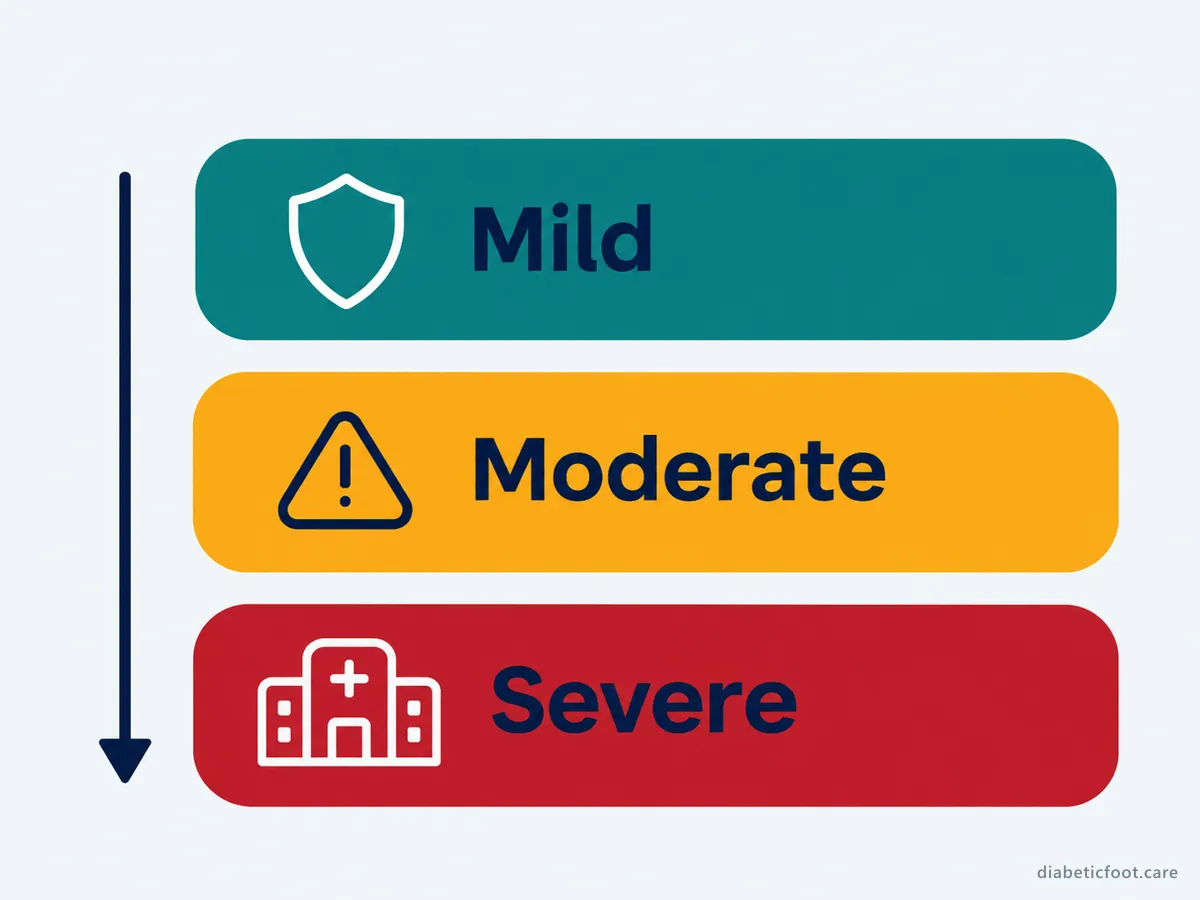
How severe a diabetic foot infection is shapes almost every later decision, from where you are treated to how quickly a surgeon gets involved. The IWGDF/IDSA system has four grades1:
| Grade | What it means | Usual setting |
|---|---|---|
| 1 – Uninfected | No signs of infection in the foot or the rest of the body | Antibiotics are not used |
| 2 – Mild | At least two local signs; redness more than 0.5 cm but less than 2 cm around the wound; only the skin and the fat beneath it involved; no whole-body signs | Usually treated outside hospital |
| 3 – Moderate | Redness 2 cm or more from the wound edge, and/or deeper tissue involved (tendon, muscle, joint or bone); no whole-body signs | Often outside hospital; a hospital stay is considered if there are major health problems such as PAD |
| 4 – Severe | Any foot infection with at least two signs of a whole-body response: temperature above 38°C or below 36°C, heart rate above 90, breathing rate above 20, or an abnormal white cell count | A hospital stay is considered |
If the bone is involved (osteomyelitis), '(O)' is added to grade 3 or 4, for example 3(O).1 A poor blood supply to the foot (ischaemia) makes infection much harder to diagnose and treat. The guideline recommends considering a hospital stay for everyone with a severe infection. It recommends the same for a moderate infection in people with other major health problems, particularly PAD.1
Deep infection, abscess and foot cellulitis
Cellulitis is an infection of the skin and the fat underneath. It makes the skin painful, hot and swollen, and having diabetes raises your risk of it.4 When redness spreads around an infected diabetic foot ulcer, it is graded using the system above.
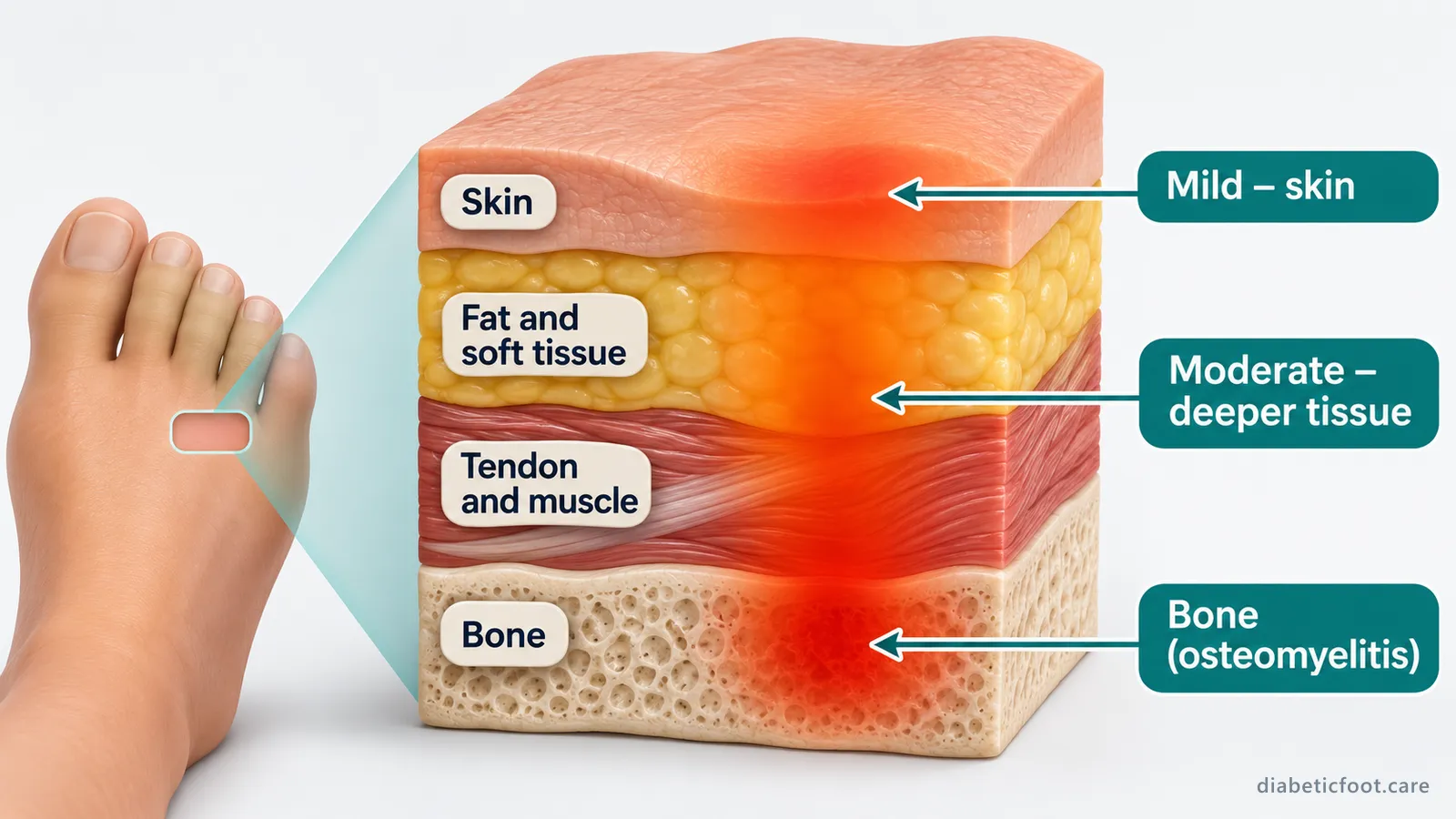
Infection can also spread under the surface into tendons, muscles, joints and the spaces between them. A diabetic foot abscess is a pocket of pus in these deep spaces. Signs of a more serious infection include1:
- redness spreading more than 2 cm, away from the ulcer or quickly, including red streaks up the leg
- a crackling feeling under the skin (crepitus), which can mean gas in the tissues
- blisters, dark patches of skin, dead tissue or gangrene
- bruising, new numbness or pain in one spot
- getting worse even though you are taking antibiotics that seem right for the infection
A surgeon should see you urgently if the infection is severe. The same goes for a moderate infection with widespread gangrene, a deep abscess, a fast, destructive (necrotising) infection or a very poor blood supply (severe ischaemia).1 Read more about diabetic foot gangrene and why amputations happen.
When is a foot infection an emergency?
A severe infection can affect your whole body. Sepsis is a life-threatening reaction to an infection. The NHS advises calling 999 or going to A&E if an adult has its warning signs.5 NICE treats some foot problems as a threat to the leg or to life, needing immediate referral to hospital emergency care. These include an ulcer with a fever or any sign of sepsis, deep infection in soft tissue or bone, a very poor blood supply to the leg (limb ischaemia) and gangrene.3
Our urgent help page has a short checklist for a diabetic foot emergency.
Which tests help confirm the infection?
Tissue samples rather than surface swabs
A culture grows germs from a sample so the lab can identify them and test which antibiotics work. The guideline prefers a small piece of tissue to a surface swab, because tissue gives more reliable results.1 It is taken under sterile conditions, either by curettage (scraping the cleaned wound base with a sterile instrument) or by biopsy.
NICE advises taking a soft tissue or bone sample from the base of the wound after dead tissue has been cleaned away (debridement). A deep swab should be used only if a sample cannot be taken.3 Samples should be taken before antibiotics start, or as close to that as possible.3
For a mild infection that started recently, in someone who has not had antibiotics lately and has no risk factors for resistant germs, it may be reasonable to start treatment without a culture.1
Blood tests and imaging
| Test | What it adds |
|---|---|
| CRP, ESR or procalcitonin | Support the diagnosis when the examination is unclear |
| White cell count, blood glucose | Help show how unwell you are |
| Plain X-ray | Shows bone changes, gas in deep tissue or something stuck in the foot; recommended routinely |
| MRI scan | Used when bone infection is still in doubt |
| Bone sample | The most reliable way to identify germs in bone |
These tests are recommended by the IWGDF/IDSA guideline and NICE.13 Our page on diabetic foot osteomyelitis explains the probe-to-bone test, MRI and biopsy in more detail.
How is a diabetic foot infection treated?
Treatment depends on how severe the infection is. Your antibiotic is chosen based on the germs most likely to be involved, any earlier culture results, antibiotics you have had before and your own preferences.3 Tablets are the first choice when possible. If you have antibiotics through a drip (intravenously), they should be reviewed within 48 hours.3 Moderate and severe infections often need early surgery to drain pus and remove dead tissue. If blood flow is poor, a vascular specialist (a blood vessel expert) is also needed.1
Good results also depend on wound care, taking pressure off the ulcer and keeping your blood glucose steady. Ulcers that are not infected should not be treated with antibiotics.1 For more on cultures, course length and surgery, see our guide to diabetic foot infection treatment. If an infection is complex or keeps coming back, an infectious diseases specialist review may help.
Can foot infections be prevented?
NICE advises against taking antibiotics to prevent a diabetic foot infection. Instead, it is better to know the symptoms and get help early.3 Diabetes UK advises checking your feet and calling your GP or foot protection team straight away about anything new, such as a cut or blister. If you cannot reach them, contact NHS 111.6
Frequently asked questions
Is foot cellulitis in diabetes serious?
It can be. Cellulitis is an infection of the skin and the fat underneath, and diabetes raises the risk. In the foot it may spread from an ulcer into deeper tissue, and early treatment can stop it becoming more serious. If your foot becomes painful, hot and swollen, ask for an urgent GP appointment or contact NHS 111. Call 999 if you also feel very unwell, confused or breathless.
Does every diabetic foot ulcer need antibiotics?
No. All ulcers have bacteria on the surface, but that is colonisation, not infection. Antibiotics are not recommended for ulcers that are not infected. They do not speed up healing or prevent infection, and they bring side effects and resistance (germs that antibiotics no longer kill). Antibiotics are kept for a diabetic foot infection, shown by at least two signs of inflammation or by signs of infection affecting the whole body.
Why is a tissue sample better than a swab?
A surface swab picks up the many germs that live harmlessly on every wound, so the result can be misleading. A small piece of tissue from the cleaned wound base shows more reliably which germs are actually causing a diabetic foot infection. That helps your team choose an antibiotic that works but is no broader than it needs to be, which also helps limit antibiotic resistance.
Can a foot infection from diabetes cause no pain?
Yes. Nerve damage can take away the feeling of pain, and poor circulation can make redness and warmth harder to spot. That is why daily foot checks matter. Tell your GP practice or foot team about swelling, a new smell, discharge or a change in colour, even if your foot does not hurt. High blood glucose with no other explanation can also be a clue.
How soon should a diabetic foot infection start to improve?
NICE advises getting medical help if your symptoms get worse quickly or a lot at any time, or do not start to improve within 1 to 2 days of starting antibiotics. Swelling and redness usually settle gradually. Once culture results are back, your team will review your treatment and may switch you to an antibiotic that targets the germ they found.
If you have signs of infection now — redness spreading, a hot swollen foot, discharge or feeling unwell — contact your GP practice, foot protection service or NHS 111 today, or call 999 if you are seriously unwell. Do not wait to contact us.

Specialist assessment in Istanbul
Would you like a specialist opinion?
Assoc. Prof. Dr. Hüsrev Diktaş is an infectious diseases and clinical microbiology specialist in Istanbul with a clinical focus on diabetic foot infections. International patients can ask about an assessment directly.
References
- International Working Group on the Diabetic Foot / Infectious Diseases Society of America. Guidelines on the diagnosis and treatment of foot infection in persons with diabetes (IWGDF/IDSA 2023). 2023. https://iwgdfguidelines.org/wp-content/uploads/2023/07/IWGDF-2023-04-Infection-Guideline.pdf
- Senneville É, et al. IWGDF/IDSA guidelines on the diagnosis and treatment of diabetes-related foot infections (IWGDF/IDSA 2023). Diabetes/Metabolism Research and Reviews (PubMed record). 2024. https://pubmed.ncbi.nlm.nih.gov/37779323/
- National Institute for Health and Care Excellence. Diabetic foot problems: prevention and management (NG19), recommendations. 2015, updated 2019. https://www.nice.org.uk/guidance/ng19/chapter/Recommendations
- NHS. Cellulitis. 2024. https://www.nhs.uk/conditions/cellulitis/
- NHS. Sepsis. 2024. https://www.nhs.uk/conditions/sepsis/
- Diabetes UK. Diabetes and foot problems. 2024. https://www.diabetes.org.uk/about-diabetes/looking-after-diabetes/complications/feet
This page gives general information for people in the UK. It is not a diagnosis and does not replace advice from your own GP, diabetes team or foot protection service. Medical disclaimer · How we write our content