In short
An early stage diabetic foot ulcer is often small and painless. Warning signs include bleeding under a callus, a blister, a crack in the skin, a red area that does not fade, or fluid on your sock. Your care team grades ulcers by depth, infection and blood supply, using systems such as SINBAD or the University of Texas classification. Get any break in the skin checked the same day.
An early stage diabetic foot ulcer is often small, painless and easy to miss, especially if nerve damage has reduced the feeling in your feet. Spotting the first changes and getting them checked quickly helps stop the wound getting deeper or infected. This guide, part of our overview of diabetic foot ulcers, explains the early signs and how ulcers are graded.
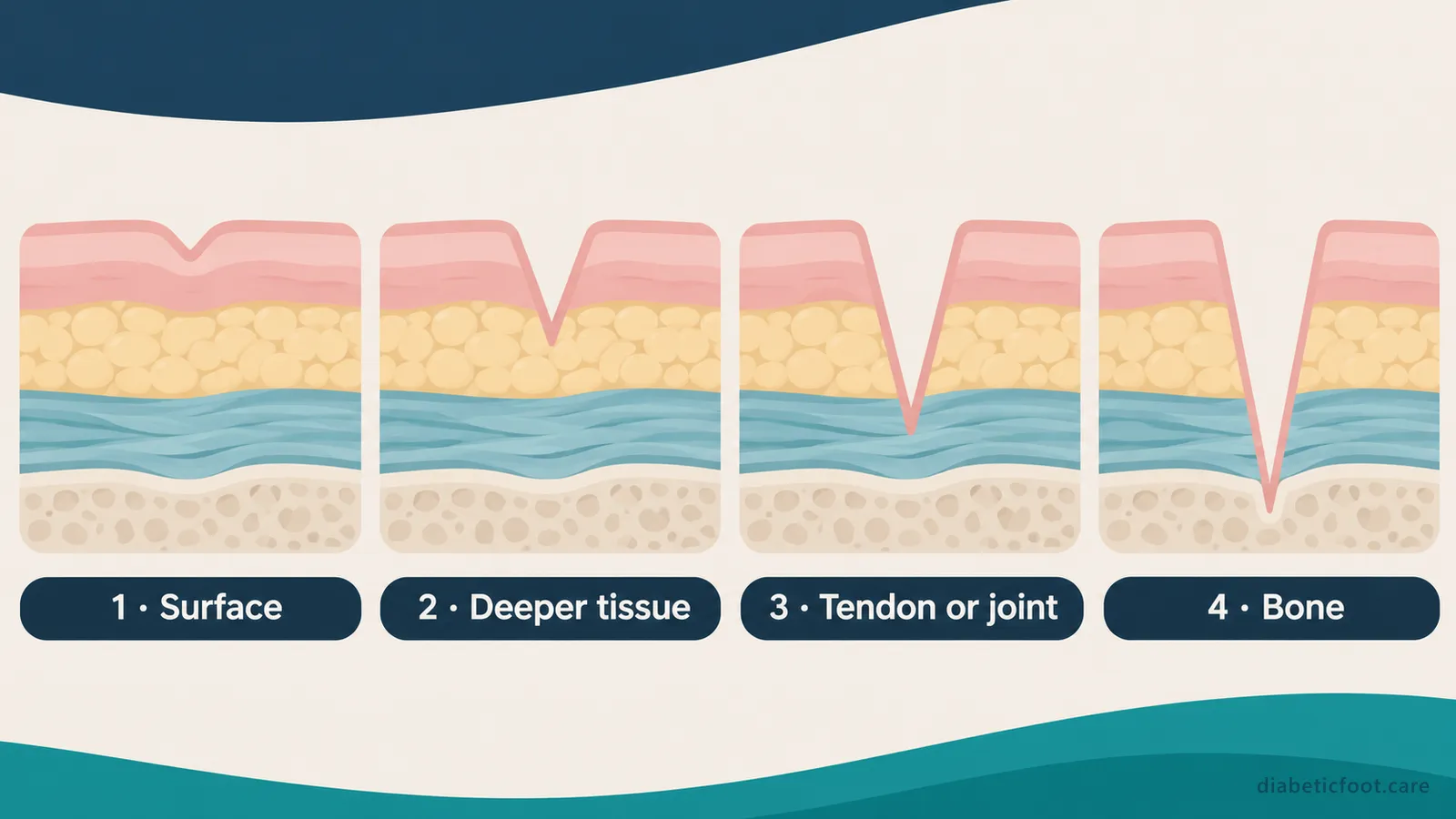
What does an early stage diabetic foot ulcer look like?
Warning changes often appear before the skin breaks. Specialists call these pre-ulcerative lesions: bleeding into or under the skin, a blister, or a shallow crack in the skin.1 Pressure first causes thick, hard skin (callus), then bleeding underneath it, and finally a break in the skin.2 Look out for:
- a callus with a dark red, brown or black spot inside it, which can mean bleeding underneath
- a blister, especially one you did not feel forming
- a patch of redness or a change in colour that does not fade after you take your shoes off
- a small crack, cut or break in the skin that is not healing
- fluid, blood or a stain on your sock or inside your shoe
- a new smell, warmth or swelling around one area3
Diabetes UK advises getting urgent help for new blisters, cuts or wounds, especially ones you cannot feel.3 For safe first aid, read our guide to diabetic foot blisters, calluses and corns.
Why we do not show ulcer pictures
We do not show wound photos, and if you search online for diabetes foot ulcer images, look at them with care. Lighting, skin tone and camera angle all change how a wound looks. A callus can also hide how deep an ulcer is, as depth is hard to judge under hard skin or dead tissue.2
A photo cannot show infection, blood supply or whether the bone is affected. NICE, which sets guidance for the NHS, says your care team should give you information that includes pictures of diabetic foot problems.4 Get any break in the skin checked, rather than comparing it with a picture.
What are the stages of a diabetic foot ulcer?
Grading, also called staging or classification, gives your care team a shared language and helps them judge urgency. Your team should record the size, depth and position of every ulcer, using a standard system such as SINBAD or the University of Texas classification.4
The Wagner grades
The Wagner system (first described by Meggitt) is the oldest and still widely quoted online5:
| Wagner grade | Description |
|---|---|
| 0 | Pre- or post-ulcerative site |
| 1 | Superficial ulcer |
| 2 | Ulcer reaching tendon or joint capsule |
| 3 | Deeper lesion involving deeper tissues |
| 4 | Gangrene of the forefoot |
| 5 | Gangrene of the whole foot |
UK guidance advises against using the Wagner system to judge how severe an ulcer is.4 It does not record ulcer size, nerve damage, infection or circulation separately, so it gives little clinical detail.5
The University of Texas classification
The University of Texas system grades an ulcer by depth, then adds a letter for infection and ischaemia (reduced blood supply)67:
| Grade | Depth | Stage letter added |
|---|---|---|
| 0 | Pre- or post-ulcerative lesion, skin fully closed | A = clean (no infection or ischaemia) |
| 1 | Superficial wound, not reaching tendon, capsule or bone | B = infection |
| 2 | Wound reaching tendon or joint capsule | C = ischaemia |
| 3 | Wound reaching bone or joint | D = infection and ischaemia |
So a shallow, clean ulcer is 1A, and a deep wound with infection and poor blood flow is 3D. In the original study, outcomes got worse as both the grade and the stage went up.6
SINBAD and the UK audit
SINBAD stands for Site, Ischaemia, Neuropathy, Bacterial infection, Area and Depth. Each item scores 0 or 1, giving a total from 0 to 6.58 It is recommended for sharing information between professionals and for audit, and is used in the National Diabetes Foot Care Audit for England and Wales.5
No grading system can predict what will happen to your own ulcer. Experts advise against using any current system to give a personal outlook.5
Blood sugar and healing an early stage diabetic foot ulcer
Over time, high blood sugar damages the small blood vessels and nerves in the feet, so wounds can take longer to heal.3 Treatment includes getting your blood sugar as well controlled as possible, with insulin if needed. Blood sugar that is getting worse can also be a sign of a new or worsening infection.2
Targets are different for everyone. Talk to your diabetes team about your readings while an ulcer heals, and do not change your medicines on your own.
What to do if you notice an early sign
Acting early matters, because a small foot problem can quickly become infected.3 If you spot any of the signs above, or think you might have an early stage diabetic foot ulcer:
- Sit down and take the weight off your foot, ideally with it raised and supported.3
- Contact your GP practice or foot protection service the same day. A problem like this should be referred to a specialist foot service within 1 working day.4
- Do not cut callus or use blades or corn plasters yourself.9
- Check both feet every day. Use a mirror or ask someone to help if you need to.9
Find out what diabetic foot ulcer treatment involves and how ulcers are helped to heal. Regular reviews also help find problems early, so go to your annual diabetic foot check and any extra reviews.
Frequently asked questions
Can an early diabetic foot ulcer heal quickly?
Some small, clean ulcers heal well when pressure is taken off and the wound is well cared for, but there is no set timescale. Healing depends on depth, blood supply, infection, blood sugar control and how well pressure is kept off the foot. Your team will measure the ulcer at each visit and change the plan if it is not getting better.
What grade is an early diabetic foot ulcer?
A shallow ulcer that has broken the skin but not reached tendon, joint or bone is usually grade 1 in both the Wagner and University of Texas systems. In the Texas system it would be 1A if clean, or 1B, 1C or 1D if there is infection, ischaemia or both. Grade 0 means the skin is unbroken, either before an ulcer forms or after one has healed.
Does an early foot ulcer always hurt?
No. Nerve damage often means an early diabetic foot ulcer causes little or no pain, so many are first spotted as a mark on a sock. Ulcers caused mainly by poor circulation are more likely to hurt. Either way, get any break in the skin checked the same day.
Can a callus hide an ulcer underneath?
Where can I see pictures of an early stage diabetic foot ulcer?
Ask your podiatrist, practice nurse or foot protection service. People with diabetic foot problems should be given information that includes pictures, so your team can show you examples and explain how they relate to your own feet. Pictures online can mislead, because a callus may hide how deep a wound is.

Specialist assessment in Istanbul
Would you like a specialist opinion?
Assoc. Prof. Dr. Hüsrev Diktaş is an infectious diseases and clinical microbiology specialist in Istanbul with a clinical focus on diabetic foot infections. International patients can ask about an assessment directly.
References
- International Working Group on the Diabetic Foot. Definitions and criteria for diabetes-related foot disease (IWGDF 2023 update). 2023. https://iwgdfguidelines.org/wp-content/uploads/2023/05/DMRR3654.pdf
- International Working Group on the Diabetic Foot. Practical guidelines on the prevention and management of diabetes-related foot disease (IWGDF 2023 update). 2023. https://iwgdfguidelines.org/wp-content/uploads/2023/07/IWGDF-2023-01-Practical-Guidelines.pdf
- Diabetes UK. Serious foot problems and diabetes. 2024. https://www.diabetes.org.uk/about-diabetes/looking-after-diabetes/complications/feet/serious-foot-problem
- NICE. Diabetic foot problems: prevention and management (NG19), Recommendations. 2015, updated 2019. https://www.nice.org.uk/guidance/ng19/chapter/Recommendations
- International Working Group on the Diabetic Foot. Guidelines on the classification of foot ulcers in people with diabetes (IWGDF 2023 update). 2023. https://iwgdfguidelines.org/wp-content/uploads/2023/07/IWGDF-2023-03-Classification-Guideline.pdf
- Armstrong DG, Lavery LA, Harkless LB. Validation of a diabetic wound classification system. Diabetes Care. 1998. https://pubmed.ncbi.nlm.nih.gov/9589255/
- Setacci C, et al. Diabetic foot: surgical approach in emergency. International Journal of Vascular Medicine. 2013. https://pmc.ncbi.nlm.nih.gov/articles/PMC3821940/
- Ince P, et al. Use of the SINBAD classification system and score in comparing outcome of foot ulcer management on three continents. Diabetes Care. 2008. https://pubmed.ncbi.nlm.nih.gov/18299441/
- Diabetes UK. How to look after your feet. 2024. https://www.diabetes.org.uk/about-diabetes/looking-after-diabetes/complications/feet/taking-care-of-your-feet
- West Suffolk NHS Foundation Trust. Looking after your diabetic foot ulcer (patient leaflet). 2020. https://www.wsh.nhs.uk/CMS-Documents/Patient-leaflets/DiabetesUnit/6567-1-Looking-after-your-diabetic-foot-ulcer.pdf
This page gives general information for people in the UK. It is not a diagnosis and does not replace advice from your own GP, diabetes team or foot protection service. Medical disclaimer · How we write our content