In short
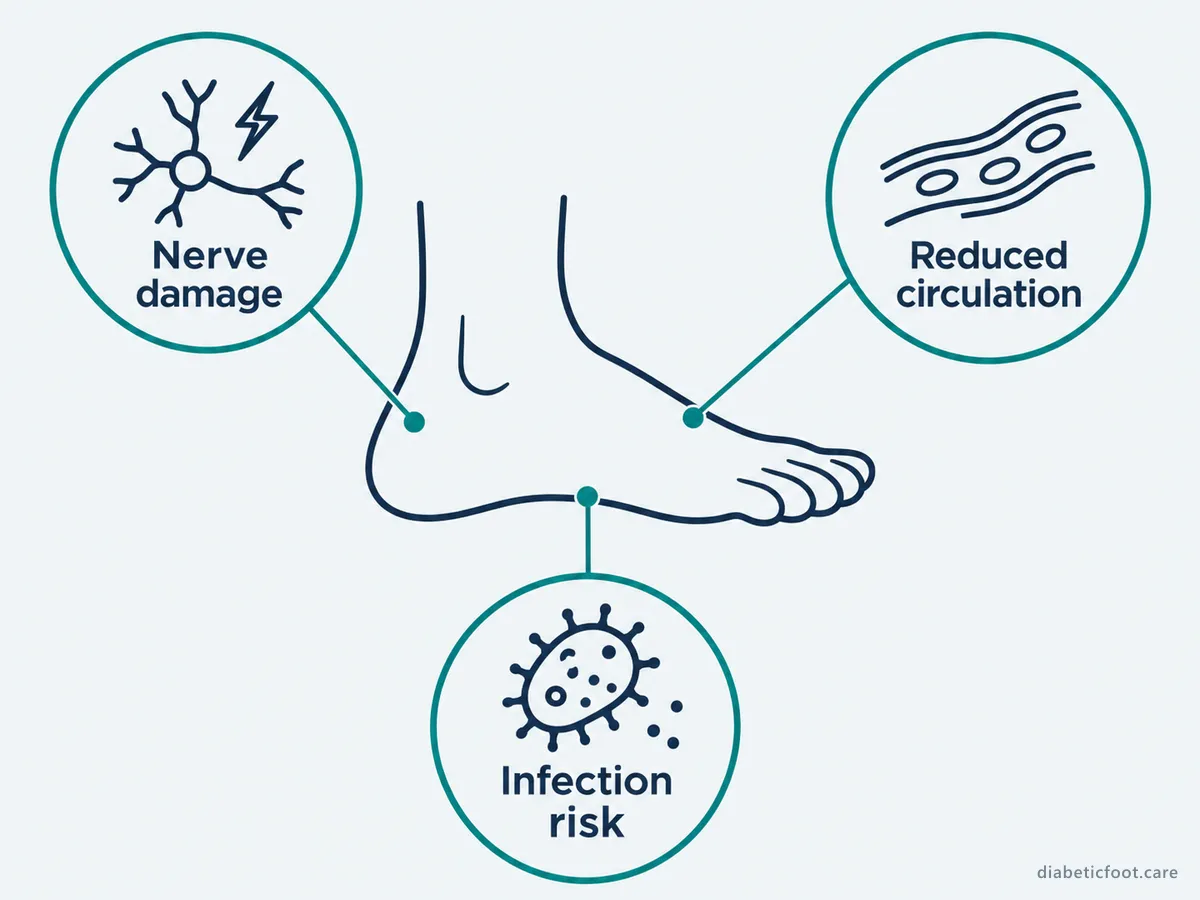
Diabetic foot is the name for foot problems caused or made worse by diabetes. The main causes are nerve damage, reduced blood flow and a higher risk of infection. These can lead to ulcers, infection, Charcot foot and, in severe cases, gangrene or amputation. Most problems can be found early if you check your feet every day and have a foot check every year. A new wound or a red, hot, swollen foot needs same-day advice.
In this section
Diabetic foot is the name for foot problems caused, or made worse, by diabetes. It covers nerve damage, poor circulation, infection, wounds and changes in the shape of the foot. This guide explains why diabetes affects your feet, the main problems, how your risk is checked in the UK and when to get help quickly.

What does diabetic foot mean?
NICE, which sets guidance for the NHS, defines a diabetic foot problem as one caused by loss of feeling (peripheral sensory neuropathy), poor circulation (peripheral arterial disease) or both. It includes foot ulcers, skin and soft tissue infection, deep damage such as heel pressure sores, osteomyelitis (bone infection) and Charcot foot.1

Specialists worldwide also use a wider term, 'diabetes-related foot disease', which includes gangrene and amputation.2
Most foot problems are not caused by diabetes itself. But diabetes and high blood sugar can make an everyday problem, like a blister or a toe injury, serious much more quickly.5
Why does diabetes affect the feet?
Over time, high blood glucose (blood sugar) can damage the nerves and small blood vessels that supply your feet.3 Four things usually work together:
- Nerve damage (neuropathy). You may lose feeling in your feet and not notice a stone in your shoe, a rubbing seam or a burn. Diabetes is the most common cause of this nerve damage in the UK.6
- Poor circulation (peripheral arterial disease, or PAD). Narrowed arteries carry less blood to your feet, so cuts and sores heal more slowly.7 Up to half of people with a diabetes-related foot ulcer have PAD. It makes poor healing, gangrene and amputation more likely.2
- Infection risk. Any break in the skin lets germs in.5 A mild or moderate infection often causes no fever or feeling of being unwell, so it is easy to underestimate.2
- Pressure and changes in foot shape. Nerve damage can change the shape of your foot and how your weight passes through it. Areas of high pressure build up hard skin (callus). This raises the pressure further and can lead to bleeding under the skin and, in time, an ulcer.2
This can happen with type 1 or type 2 diabetes. The NHS lists foot ulcers and infections as long-term complications of type 2 diabetes that can sometimes lead to amputation.8
The main diabetic foot problems
Nerve damage and foot pain
Nerve damage can cause tingling, burning or shooting pain, or take away feeling without any pain, which is easy to miss.6 Read more about diabetic foot pain and nerve damage.
Skin changes, spots and rashes
Dry skin, cracks, fungal infections and skin conditions linked to diabetes are common. Some are harmless; others are early warning signs. Our page on red spots, rashes and other skin changes explains how to tell them apart.
Blisters, calluses and corns
These are signs of too much pressure or rubbing and can come before an ulcer. Find out why blisters and calluses matter and how to look after them safely.
Foot ulcers
An ulcer is an open wound that needs prompt care from a health professional. See our guide to diabetic foot ulcers.
Infection
Infection can start in an ulcer, crack or blister and spread deeper, even into the bone. Learn how foot infections are recognised and treated. Deep or complicated infections may need infectious diseases specialist review as part of a wider team.
Charcot foot
In Charcot foot, the bones and joints of a numb foot are damaged and the foot can change shape. It often shows up as a red, hot, swollen foot.1 Read about Charcot foot and its warning signs.
Poor circulation and gangrene
If the blood supply is badly reduced, sometimes with infection too, tissue can die (gangrene).10 Our page on gangrene in the diabetic foot and amputation risk explains how foot teams work to prevent it.
Nail problems
Thick, discoloured or ingrown toenails can damage the skin around them. If you think you have a fungal nail infection, see a GP.11
Common symptoms to look out for
See your GP or local foot protection team if you notice any of these:3
- tingling, burning pain or loss of feeling
- swollen feet
- wounds that do not heal
- cramp in your calves
- shiny, smooth skin or hair loss on your legs and feet
Nerve damage can hide pain, so looking at your feet matters as much as how they feel. Our page on early diabetic foot symptoms groups these by cause and explains which need help the same day.
Who is at risk? NICE foot risk levels
Every adult with diabetes in the UK should have their foot risk checked at diagnosis and at least once a year.1 There are four risk groups:
| Risk level | What it means | How often feet are checked again |
|---|---|---|
| Low | No risk factors, apart from callus on its own | Every year, at your annual diabetes review |
| Moderate | Foot deformity, nerve damage or PAD | Often, for example every 3 to 6 months, by the foot protection service |
| High | An ulcer or amputation in the past, kidney dialysis or similar treatment, nerve damage with PAD, or nerve damage or PAD with callus or deformity | More often, for example every 1 to 2 months if there is no immediate concern |
| Active problem | An ulcer, infection, severe loss of blood supply (chronic limb-threatening ischaemia), gangrene, possible acute Charcot foot, or a hot, swollen foot with a colour change and no clear cause | Referral to a specialist foot team within 1 working day, or straight away if your leg or life is at risk |
Source: NICE NG19.1
After each check, ask which group you are in. Diabetes UK says people with diabetes are up to 20 times more likely to have an amputation, so foot problems need prompt action.5
How diabetic foot problems are assessed in the UK
The annual foot check
At a foot check, a trained professional examines both feet with your shoes, socks and any dressings off. They test for nerve damage with a 10 g monofilament (a thin nylon thread pressed on your skin). They also look for reduced blood supply, ulcers, callus, infection or inflammation, deformity, gangrene and Charcot foot.1 The check is part of your annual diabetes review and is free on the NHS.3 Read what happens at your annual foot review.
Being referred to a foot protection service
If you are at moderate or high risk, you should be referred to a foot protection service, led by a specially trained podiatrist (foot specialist). First appointments should be within 2 to 4 weeks for high risk and 6 to 8 weeks for moderate risk. The service looks after your skin and nails, checks your footwear needs and checks your circulation.1
The hospital foot team
Problems the foot protection service cannot manage go to the hospital foot team (the multidisciplinary foot care service). It includes diabetes doctors, podiatrists, vascular and orthopaedic surgeons, microbiologists and wound care staff.1
Can foot problems in diabetes be prevented?
Most foot problems can be prevented with good foot care and yearly checks.3 What you can do:
- Check both feet every day, including between your toes and the soles.4
- Keep your blood sugar, blood pressure and cholesterol as close to target as you can, and get help to stop smoking.4
- Wear well-fitting shoes and socks, indoors and outdoors, rather than going barefoot.2
- Ask a podiatrist to deal with corns and hard skin, rather than using blades or corn plasters.4
Our section on looking after your feet every day covers washing, nails and footwear.
When to get help urgently
While you wait, keep weight off the foot.5 This website cannot assess a diabetic foot emergency, so always use local NHS services first. Our page on when to seek urgent help has a fuller checklist.
Frequently asked questions
What foot diseases does diabetes cause?
The main ones are nerve damage (neuropathy), poor circulation (peripheral arterial disease), foot ulcers, skin and soft tissue infection, bone infection (osteomyelitis), Charcot foot and gangrene. Dry, cracked skin, calluses and fungal infections are also common and can lead to worse problems if not treated. Many people have several at once, which is why a diabetic foot check looks at nerves, circulation and skin together.
Are foot problems in diabetics always serious?
No. Many start small, such as dry skin or a little hard skin. The worry is that numbness and poor blood flow can let a minor problem turn into an ulcer or infection quickly, sometimes without pain. So have any new break in the skin, blister, swelling or colour change checked promptly by your GP practice, podiatrist or foot protection service rather than watched for weeks.
Do people with type 2 diabetes get foot problems?
Yes. Both type 1 and type 2 diabetes can cause foot problems, and the NHS lists foot ulcers and infections among the long-term complications of type 2 diabetes. Nerve damage, poor circulation and smoking all add to the risk. Keeping your blood sugar, blood pressure and cholesterol close to target, and going to every annual review, helps lower the chance of complications.
How often should my feet be checked?
Every adult with diabetes should have their feet checked at diagnosis and at least once a year. If you are at moderate or high risk, you will need checks more often (see the table above). You should also look at your own feet every day. If you cannot see or reach your feet, ask a family member, carer or your diabetes team to help.
Who looks after diabetic foot problems in the NHS?
Your GP practice usually does the annual foot check. If you are at moderate or high risk, you will be referred to a foot protection service, led by a specialist podiatrist. Ulcers, infection, Charcot foot and other active diabetic foot problems are managed with the hospital foot team. Ask your practice now how to contact your local foot team quickly, so you have the number ready.

Specialist assessment in Istanbul
Would you like a specialist opinion?
Assoc. Prof. Dr. Hüsrev Diktaş is an infectious diseases and clinical microbiology specialist in Istanbul with a clinical focus on diabetic foot infections. International patients can ask about an assessment directly.
References
- National Institute for Health and Care Excellence (NICE). Diabetic foot problems: prevention and management (NG19), Recommendations. 2015, last updated 2019. https://www.nice.org.uk/guidance/ng19/chapter/Recommendations
- International Working Group on the Diabetic Foot (IWGDF). Practical guidelines on the prevention and management of diabetes-related foot disease (IWGDF 2023 update). 2023. https://iwgdfguidelines.org/wp-content/uploads/2023/07/IWGDF-2023-01-Practical-Guidelines.pdf
- Diabetes UK. Diabetes and foot problems. 2024. https://www.diabetes.org.uk/about-diabetes/looking-after-diabetes/complications/feet
- Diabetes UK. How to look after your feet. 2024. https://www.diabetes.org.uk/about-diabetes/looking-after-diabetes/complications/feet/taking-care-of-your-feet
- Diabetes UK. Serious foot problems and diabetes. 2024. https://www.diabetes.org.uk/about-diabetes/looking-after-diabetes/complications/feet/serious-foot-problem
- NHS. Peripheral neuropathy. 2022. https://www.nhs.uk/conditions/peripheral-neuropathy/
- NHS. Peripheral arterial disease (PAD). 2026. https://www.nhs.uk/conditions/peripheral-arterial-disease-pad/
- NHS. Complications of type 2 diabetes. 2025. https://www.nhs.uk/conditions/type-2-diabetes/complications/
- NHS. Sepsis. 2026. https://www.nhs.uk/conditions/sepsis/
- NHS. Gangrene. 2026. https://www.nhs.uk/conditions/gangrene/
- NHS. Fungal nail infection. 2024. https://www.nhs.uk/conditions/fungal-nail-infection/
This page gives general information for people in the UK. It is not a diagnosis and does not replace advice from your own GP, diabetes team or foot protection service. Medical disclaimer · How we write our content