In short
Diabetic foot ulcer treatment involves taking pressure off the wound, removing dead tissue and callus, treating any infection, checking and improving blood flow, managing blood sugar and using suitable dressings. A knee-high cast or boot that cannot be taken off is often the first choice for ulcers on the sole. Healing time varies a lot, and the plan is reviewed if the ulcer is not getting better.
Diabetic foot ulcer treatment rests on a few simple ideas: take pressure off the wound, clear away dead tissue, treat infection, improve blood flow and support healing with good diabetes care. This page, part of our complete guide to diabetic foot ulcers, explains each step, the extra treatments you may hear about and what affects healing time.

The core principles of diabetic foot ulcer treatment
NICE, which sets guidance for the NHS, lists five parts of standard care: offloading, treating infection, treating ischaemia (poor blood supply), debridement (removing dead tissue) and dressings.1 International guidance adds whole-person care, such as blood sugar control, nutrition and treating swelling.2
| Principle | What it involves | Why it matters |
|---|---|---|
| Offloading | Cast, boot or device that takes pressure off the ulcer | Ongoing pressure stops healing |
| Debridement | Removing callus and dead tissue | Shows the true size and helps healing |
| Infection control | Samples, then antibiotics if infected | Infection threatens the foot and leg |
| Blood flow | Circulation tests and, if needed, revascularisation | Poor circulation slows or stops healing |
| Whole-person care | Blood sugar, nutrition, swelling, mood | These affect how well tissue repairs |
| Dressings | Chosen to manage fluid and protect the wound | Help, but cannot replace, the above |
In the UK, diabetic foot ulcer treatment is shared between a foot protection service and a hospital foot team (the multidisciplinary foot care service), which includes podiatry, diabetes medicine, vascular surgery, microbiology, orthopaedics, casting and wound care.1
Offloading: taking pressure off the ulcer
Offloading means taking pressure off the ulcer. For an ulcer caused by nerve damage on the front or middle of the sole, the first choice is a knee-high device you cannot take off. This is either a total contact cast (a close-fitting cast moulded to your foot and lower leg) or a walker boot made non-removable.3 UK guidance also recommends a non-removable cast here if there is no infection or poor blood supply.1
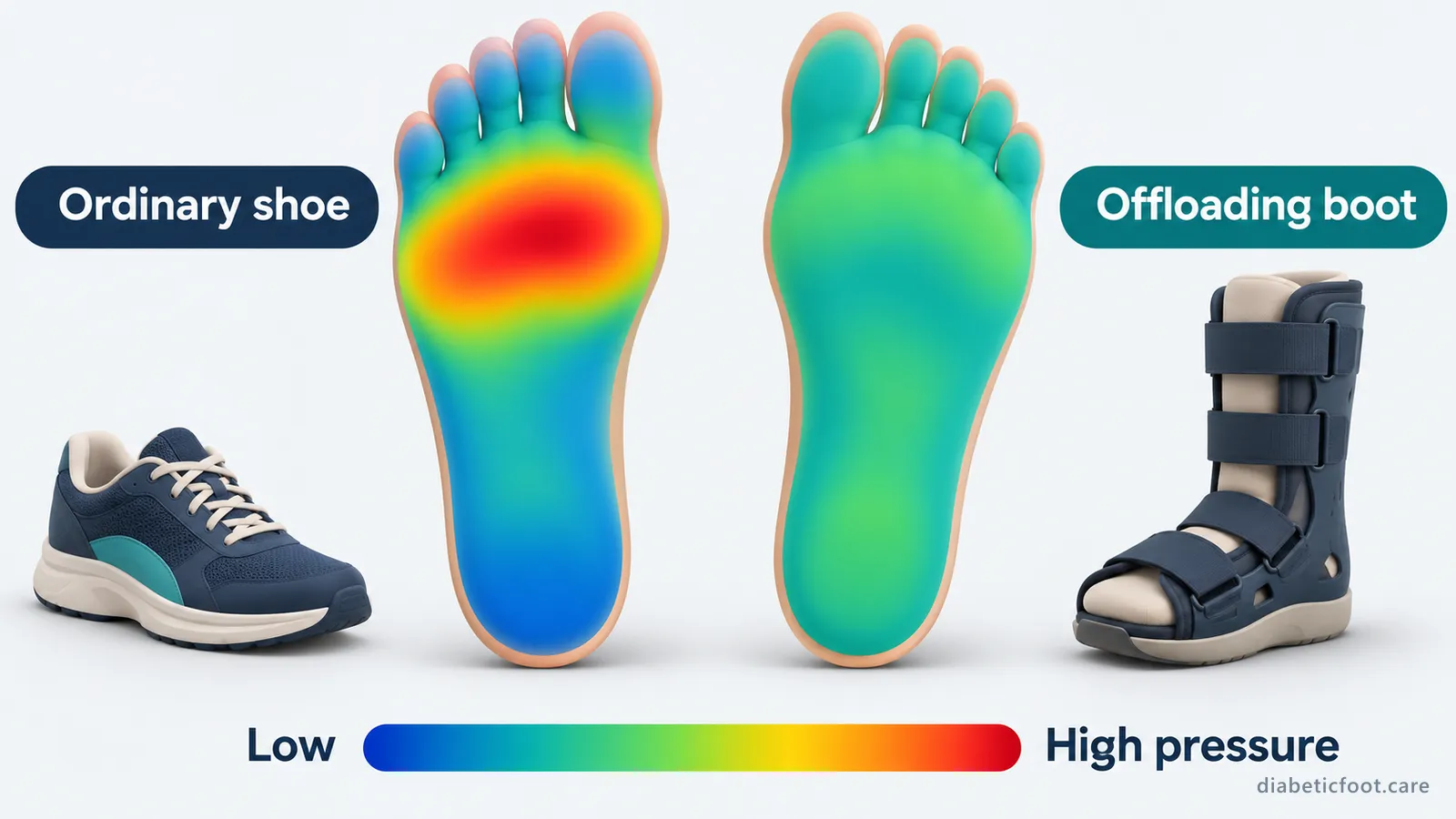
If a non-removable device is not suitable or you cannot cope with it, the next choice is a removable knee-high or ankle-high device. Wear it whenever you are on your feet, including at home.3 Ordinary shoes, even standard therapeutic footwear, should not be used instead.3 If there is infection or poor circulation, offloading is still used, but the team chooses the device more carefully.3
If an ulcer under the ball of the foot or the big toe does not heal with these measures, surgery to reduce pressure may be considered, such as lengthening the Achilles tendon or releasing a toe tendon.3 A raise on your other shoe can make walking in a boot more balanced and comfortable.3
Debridement: removing dead tissue and callus
Debridement means removing callus and dead or unhealthy tissue to leave a clean wound.4 The usual method is sharp debridement with a scalpel or similar instrument, as often as the wound needs.4 Only professionals with the right training and skills should do it.1
Other methods, such as enzymes, ultrasound or larvae (maggot therapy), are not recommended over sharp debridement. Enzyme products may be considered where sharp debridement is not available.4 An ulcer that is not infected but shows signs of severely reduced blood supply should not be debrided.2
Treating infection
Infection is an immediate threat to the foot. If infection is suspected, antibiotics should start as soon as possible, after a tissue sample is taken where possible, then reviewed once results are back.1 Ulcers that are not infected do not get antibiotics just in case.1
For infections of the skin and soft tissue, 1 to 2 weeks of antibiotics is often enough. Longer courses may be needed if the infection is slow to clear or there is severe artery disease. Deep or widespread infection needs an urgent check for surgery to drain pus (an abscess) or remove dead tissue.2 Read more about diabetic foot infection treatment, including antibiotics, cultures and surgery. For complex or repeated infections, an infectious diseases specialist opinion alongside the foot team may help.
Checking blood flow and revascularisation
If poor blood supply (ischaemia) is found, the team should always consider treating it.2 Revascularisation means restoring blood flow. It can be done from inside the artery (an endovascular procedure) or with bypass surgery.2 The aim is to get blood flowing directly to at least one artery in the foot, ideally the one supplying the wound.2
If an ulcer shows no signs of healing within 4 to 6 weeks despite good care, the team should consider angiography (imaging of the arteries) and revascularisation, even if earlier tests looked reassuring.2 Medicines that aim to improve circulation have not been shown to help ulcers heal.4
Glucose, general health and dressings
Your team will aim to control your blood sugar as well as possible, with insulin if needed, as it affects healing and infection.2 Swelling, poor nutrition, heart and circulation risks and low mood are also treated where possible.2 Stopping smoking helps blood flow to your feet.5
Dressings should manage extra fluid and keep the wound moist.2 They are chosen to suit your wound, as assessed by your team, and your preferences.1 For practical home care, see our guide to diabetic foot ulcer dressings and wound care at home.
What other diabetic foot ulcer treatments are there?
Some treatments are added only when standard care has not been enough, and guidance differs on some:
| Treatment | UK guidance (NICE) | International guidance (IWGDF) |
|---|---|---|
| Sucrose octasulfate dressing | Not covered | Consider for non-infected neuroischaemic ulcers not improving after at least 2 weeks of standard care including offloading4 |
| Negative pressure wound therapy (NPWT, gentle suction through a sealed dressing) | Consider after surgical debridement, on specialist advice1 | Consider for wounds after surgery; not for ulcers that have not had surgery4 |
| Hyperbaric oxygen therapy (breathing oxygen in a pressurised chamber) | Do not offer except in a clinical trial1 | Consider for ischaemic or neuroischaemic ulcers where standard care has failed and the service exists4 |
| Skin substitutes | Consider only if healing has stalled, on specialist advice1 | Not suggested for routine use4 |
| Growth factors, platelet-rich plasma gel, electrical stimulation | Do not offer except in a clinical trial1 | Generally not suggested4 |
Honey and herbal products are not recommended for healing foot ulcers.4
How long does a diabetic foot ulcer take to heal?
There is no standard healing time. It depends on the ulcer's size and depth, blood supply, infection, blood sugar control, other health conditions and, importantly, how consistently pressure is kept off the wound.2 Most ulcers can heal when treatment follows these principles,2 but timescales vary a lot between people.
How often you are seen during diabetic foot ulcer treatment depends on your overall health, how healing is going and whether anything gets worse.1 If an ulcer is not improving after 4 to 6 weeks of good care, the team will usually look again at blood flow, infection, offloading and whether other treatments might help.2 No scoring system can reliably predict how your own ulcer will progress.6
Not sure if a skin change is an ulcer at all? See our guide to early stage diabetic foot ulcer signs and stages.
Frequently asked questions
Can a diabetic foot ulcer heal on its own?
It is unlikely to heal reliably without treatment, because the causes, such as pressure on a numb foot or poor circulation, are usually still there. During diabetic foot ulcer treatment, your care team will remove callus and dead tissue, take pressure off the foot, check blood flow and treat infection. Contact your GP practice or foot protection service the same day if you find a new ulcer.
What is a total contact cast?
A total contact cast is a knee-high cast used in diabetic foot ulcer treatment, moulded closely to your foot and lower leg. It spreads weight away from the ulcer. You cannot take it off at home, so it keeps working all day. Trained staff usually change and check it regularly. A walker boot made non-removable does a similar job.
Do I have to wear my offloading boot all the time?
If your boot is removable, wear it whenever you are on your feet, including short walks around the house at night. Even a few steps without it put pressure back on the ulcer. Ask your team when it is safe to take it off, for example for washing, and how to protect your other foot, which takes extra load.
Is hyperbaric oxygen therapy used for diabetic foot ulcers in the UK?
NICE does not recommend hyperbaric oxygen therapy for diabetic foot ulcers outside clinical trials. International guidance says it may be considered for some ulcers with poor blood supply when standard care has not worked and the service is available. In the UK, it may be considered only in specialist settings, after offloading, debridement, infection and blood flow have all been dealt with.
Will diabetic foot ulcer treatment include surgery?
Many ulcers heal without surgery. You may need an operation to drain an abscess or remove dead or infected tissue, to restore blood flow, or to reduce pressure when an ulcer keeps failing to heal, for example by lengthening a tendon. Your team will explain the reasons, benefits and risks of any operation they suggest.

Specialist assessment in Istanbul
Would you like a specialist opinion?
Assoc. Prof. Dr. Hüsrev Diktaş is an infectious diseases and clinical microbiology specialist in Istanbul with a clinical focus on diabetic foot infections. International patients can ask about an assessment directly.
References
- NICE. Diabetic foot problems: prevention and management (NG19), Recommendations. 2015, updated 2019. https://www.nice.org.uk/guidance/ng19/chapter/Recommendations
- International Working Group on the Diabetic Foot. Practical guidelines on the prevention and management of diabetes-related foot disease (IWGDF 2023 update). 2023. https://iwgdfguidelines.org/wp-content/uploads/2023/07/IWGDF-2023-01-Practical-Guidelines.pdf
- International Working Group on the Diabetic Foot. Guidelines on offloading foot ulcers in persons with diabetes (IWGDF 2023 update). 2023. https://iwgdfguidelines.org/wp-content/uploads/2023/07/IWGDF-2023-06-Offloading-Guideline.pdf
- International Working Group on the Diabetic Foot. Guidelines on interventions to enhance healing of foot ulcers in people with diabetes (IWGDF 2023 update). 2023. https://iwgdfguidelines.org/wp-content/uploads/2023/07/IWGDF-2023-07-Wound-Healing-Guideline.pdf
- East Sussex Healthcare NHS Trust. Looking after your foot ulcer (patient leaflet). 2020. https://www.esht.nhs.uk/wp-content/uploads/2020/05/0807.pdf
- International Working Group on the Diabetic Foot. Guidelines on the classification of foot ulcers in people with diabetes (IWGDF 2023 update). 2023. https://iwgdfguidelines.org/wp-content/uploads/2023/07/IWGDF-2023-03-Classification-Guideline.pdf
This page gives general information for people in the UK. It is not a diagnosis and does not replace advice from your own GP, diabetes team or foot protection service. Medical disclaimer · How we write our content