In short
Diabetic foot infection treatment depends on how severe the infection is. Your team takes a deep tissue sample, starts an antibiotic aimed at the most likely germs, then narrows it once culture results come back. Soft tissue infections usually need 1 to 2 weeks of antibiotics; bone infection can need longer. Pus or dead tissue often needs surgery. Ulcers that are not infected are not treated with antibiotics, and you should never treat yourself.
Diabetic foot infection treatment combines three things: the right samples, carefully chosen antibiotics and, when needed, surgery to remove pus or dead tissue. This page explains how your care team chooses, based on UK and international guidance. It builds on our overview of diabetic foot infection signs and grading. It describes general principles, not a plan for you: your own team decides your treatment.

How is diabetic foot infection treatment decided?
The starting point is how severe the infection is. Using the IWGDF/IDSA system, it is graded as mild, moderate or severe.4 The grade helps decide whether you can be treated at home, whether antibiotics are given as tablets or into a vein, and how quickly a surgeon is involved.1
NICE, which sets guidance for the NHS, says the choice of antibiotic should take account of2:
- how severe the infection is (mild, moderate or severe)
- the risk of complications
- the results of any earlier cultures
- antibiotics you have had before
- your own preferences
The IWGDF/IDSA guideline also looks at which germs are likely or proven, which antibiotics they respond to and how well a medicine works in foot infections.1 Side effects (including harm to the body's normal bacteria), interactions with your other medicines, availability and cost matter too. Almost all mild infections, and many moderate ones in people without major health problems, can be treated outside hospital.1
Why are cultures taken before antibiotics?
A culture means growing the germs from a sample, so the lab can identify them and test which antibiotics work. The guideline prefers a tissue culture to a surface swab.1 It is taken under sterile conditions by curettage (scraping the cleaned wound base with a sterile instrument) or biopsy. NICE advises taking a soft tissue or bone sample from the base of the wound once dead tissue has been cleaned away (debridement). A deep swab should be used only if tissue cannot be taken.2
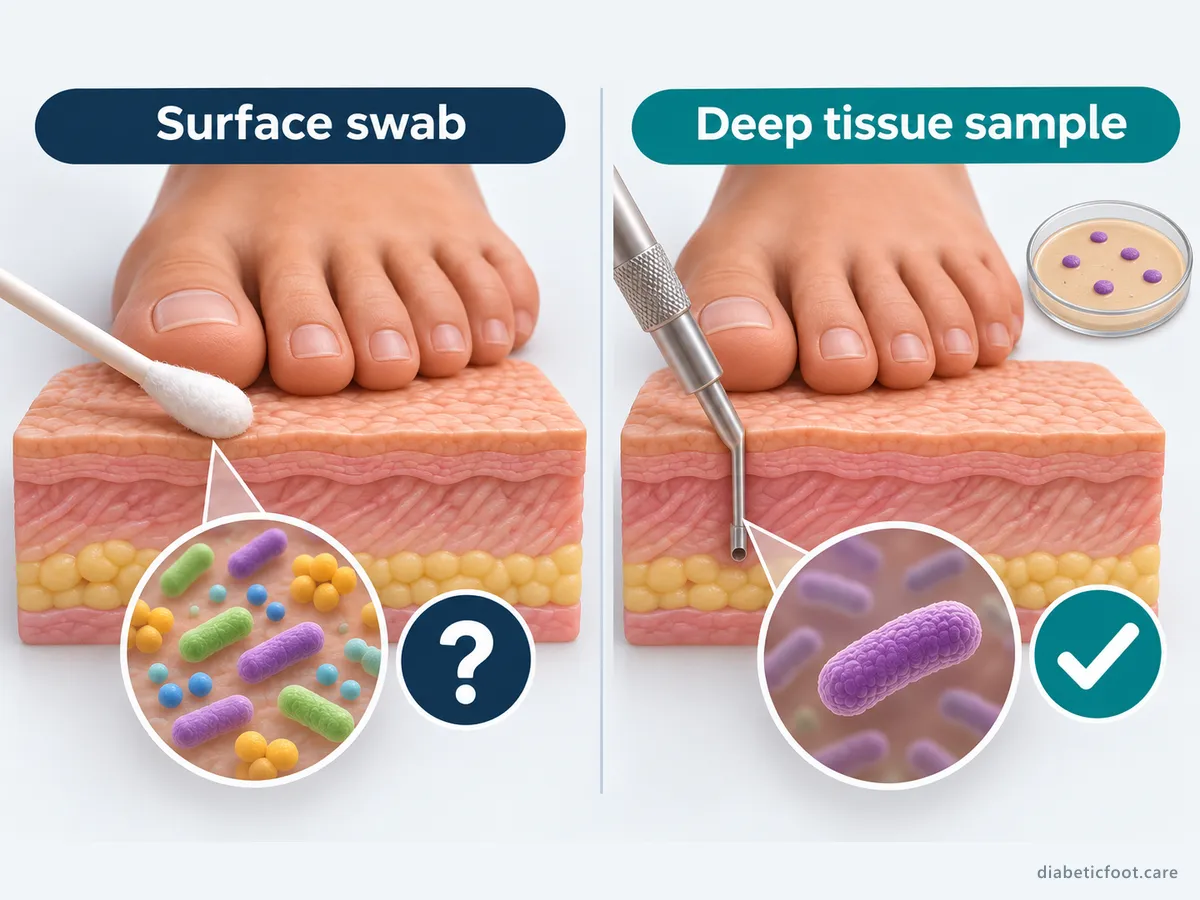
Timing matters. NICE recommends taking samples before the first dose of antibiotics, or as close to it as possible, while still starting treatment as soon as possible.2 Standard culture is still the first-choice lab method, rather than newer genetic (molecular) tests.1
For a mild infection in someone who has not had antibiotics recently and has no particular risk of resistant germs, it may be reasonable to start treatment without a culture.1
Starting antibiotics, then targeting them
Antibiotics usually start before the results are known. This is called empirical treatment: an informed choice based on how severe the infection is and the most likely germs.
- Mild infection, no recent antibiotics, in a temperate climate such as the UK: the guideline advises aiming only at common gram-positive bacteria, such as streptococci and Staphylococcus aureus.1
- Moderate or severe infection: a broader first choice, often given into a vein to begin with. It covers a wider range of bacteria and is then adjusted to how you respond and to the culture results.3
- Pseudomonas: in temperate climates, this germ is not routinely targeted unless it has recently been grown from the affected area.1
When the results arrive, NICE advises reviewing the antibiotic and switching to a narrower one where appropriate.2
Tablets or a drip?
NICE recommends antibiotic tablets as the first choice if you can take them and the infection does not need treatment into a vein (intravenous treatment).2 If you are having antibiotics through a drip, they should be reviewed within 48 hours, and a switch to tablets considered where possible.2
A hospital stay is considered for a severe infection, or a moderate one in people with major health problems such as peripheral artery disease (narrowed leg arteries).1 Other reasons include unstable blood pressure or blood glucose, needing a drip or surgery, or treatment at home that is not working.1
Antibiotic duration for diabetic foot infection
NICE advises basing the length of the course on how severe the infection is and how well it responds. Whether you still need antibiotics should be reviewed regularly.2 The IWGDF/IDSA guideline gives these typical ranges1:
| Situation | Typical guideline range |
|---|---|
| Skin and soft tissue infection | 1 to 2 weeks |
| Extensive soft tissue infection improving slowly, or severe artery disease | Up to 3 to 4 weeks may be considered |
| Bone infection, all infected bone removed | A few days |
| Bone infection, infected bone left at the edge after minor amputation | Up to 3 weeks |
| Bone infection treated without surgery | 6 weeks |
These are ranges from guidelines, not instructions. Your team decides the right length for you. If the infection has not settled after 4 weeks of treatment that seems right, the guideline advises looking again at the diagnosis and the plan.1 Bone infection is explained in our article on diabetic foot osteomyelitis.
When is surgery part of diabetic foot infection treatment?
Antibiotics do not reach pus or dead tissue well, so these often need to be removed. The guideline recommends an urgent surgical opinion for a severe infection, or a moderate one with widespread gangrene, a fast, destructive (necrotising) infection, a deep abscess, compartment syndrome (a dangerous build-up of pressure inside the foot) or a very poor blood supply (severe ischaemia).1
For moderate and severe infections, it suggests considering early surgery, within 24 to 48 hours, alongside antibiotics to remove infected and dead tissue.1 Treating a diabetic foot abscess usually means draining it in an operation. If you have peripheral artery disease, a vascular specialist (blood vessel expert) should be involved urgently. They help plan the drainage and any procedure to restore blood flow (revascularisation).13
Surgery is only one part of care. Taking pressure off the foot (offloading), regular wound care and blood glucose control carry on throughout. Read about diabetic foot ulcer treatment.
What is not recommended?
- Antibiotics for ulcers that are not infected. They should not be used to help healing or to prevent infection,1 and NICE advises against antibiotics to prevent foot infections.2
- Some add-on treatments for infection. The guideline suggests not using antiseptics or silver products on the wound, honey, bacteriophage therapy (viruses that attack bacteria) or negative pressure wound therapy (a vacuum dressing) to treat infection. It also suggests not adding antibiotic creams or ointments to antibiotics taken by mouth or into a vein.1
- Oxygen therapy just for infection. Hyperbaric oxygen (breathing oxygen in a pressurised chamber) or oxygen applied to the wound is not suggested when the only aim is to treat the infection.1
Antimicrobial stewardship and resistance
Antimicrobial stewardship means using antibiotics carefully, so they treat the infection while keeping resistance and side effects as low as possible. For diabetic foot infection treatment, the guideline sets out these principles1:
- deal with the source of the infection, with surgery if possible
- start with the narrowest suitable antibiotic, for the shortest time that works
- use the safest route
- then switch to a targeted antibiotic based on cultures, preferably as tablets
What this means for you:
- take antibiotics exactly as prescribed, and do not stop or extend a course without advice
- never use leftover or borrowed antibiotics for a foot problem
- tell the person who prescribed them about any side effects
Some infections are complex, keep coming back or involve resistant germs. In these cases an infectious diseases opinion on antibiotic choice can support your local team.
Frequently asked questions
What antibiotics are used for diabetic foot ulcers?
There is no single answer. In diabetic foot infection treatment, the choice depends on how severe the infection is, which germs are likely or have been grown, and antibiotics you have had before. Allergies, how well your kidneys work and possible interactions with other medicines matter too. Mild infections are usually aimed at common skin bacteria; more severe ones may need broader cover at first. Only a health professional who has examined you should choose an antibiotic, and it should be reviewed when culture results arrive.
How long do antibiotics take to work on a foot infection?
Improvement is usually gradual, and the wound itself takes longer to heal than the infection takes to settle. NICE advises getting medical help if your symptoms do not start to improve within 1 to 2 days, or get worse at any point. If things are not improving, the germ may be resistant, an abscess may need draining, the bone may be involved or blood flow may be poor.
Can I stop diabetic foot infection treatment once my foot looks better?
Do not stop or change antibiotics on your own. Your team sets the length of the course based on how severe the infection is and how you respond, and may shorten or extend it after a review. Taking antibiotics for longer than needed increases side effects and resistance, so the course is reviewed rather than fixed in advance. If you have side effects, contact the person who prescribed them rather than stopping.
How is a diabetic foot abscess treated?
An abscess is a pocket of pus, often deep in the foot. Antibiotics alone rarely clear it. Treatment usually means an operation to drain it and remove dead tissue, together with antibiotics guided by samples taken during the operation. If blood flow is poor, a vascular specialist is involved. Signs of a deep abscess, such as swelling or pain that is quickly getting worse, need urgent assessment.
What is antimicrobial stewardship?
It means prescribing antibiotics responsibly. That includes using them only when there is an infection, choosing the narrowest option that works, giving them for the shortest time that works and reviewing them when results come back. People with diabetes may need antibiotics several times, so stewardship helps keep diabetic foot infection treatment working in future and reduces side effects.
If you have signs of infection now — redness spreading, a hot swollen foot, discharge or feeling unwell — contact your GP practice, foot protection service or NHS 111 today, or call 999 if you are seriously unwell. Do not wait to contact us.

Specialist assessment in Istanbul
Would you like a specialist opinion?
Assoc. Prof. Dr. Hüsrev Diktaş is an infectious diseases and clinical microbiology specialist in Istanbul with a clinical focus on diabetic foot infections. International patients can ask about an assessment directly.
References
- International Working Group on the Diabetic Foot / Infectious Diseases Society of America. Guidelines on the diagnosis and treatment of foot infection in persons with diabetes (IWGDF/IDSA 2023). 2023. https://iwgdfguidelines.org/wp-content/uploads/2023/07/IWGDF-2023-04-Infection-Guideline.pdf
- National Institute for Health and Care Excellence. Diabetic foot problems: prevention and management (NG19), recommendations. 2015, updated 2019. https://www.nice.org.uk/guidance/ng19/chapter/Recommendations
- International Working Group on the Diabetic Foot. Practical guidelines on the prevention and management of diabetes-related foot disease (IWGDF 2023 update). 2023. https://iwgdfguidelines.org/wp-content/uploads/2023/07/IWGDF-2023-01-Practical-Guidelines.pdf
- Senneville É, et al. IWGDF/IDSA guidelines on the diagnosis and treatment of diabetes-related foot infections (IWGDF/IDSA 2023). Diabetes/Metabolism Research and Reviews (PubMed record). 2024. https://pubmed.ncbi.nlm.nih.gov/37779323/
This page gives general information for people in the UK. It is not a diagnosis and does not replace advice from your own GP, diabetes team or foot protection service. Medical disclaimer · How we write our content